
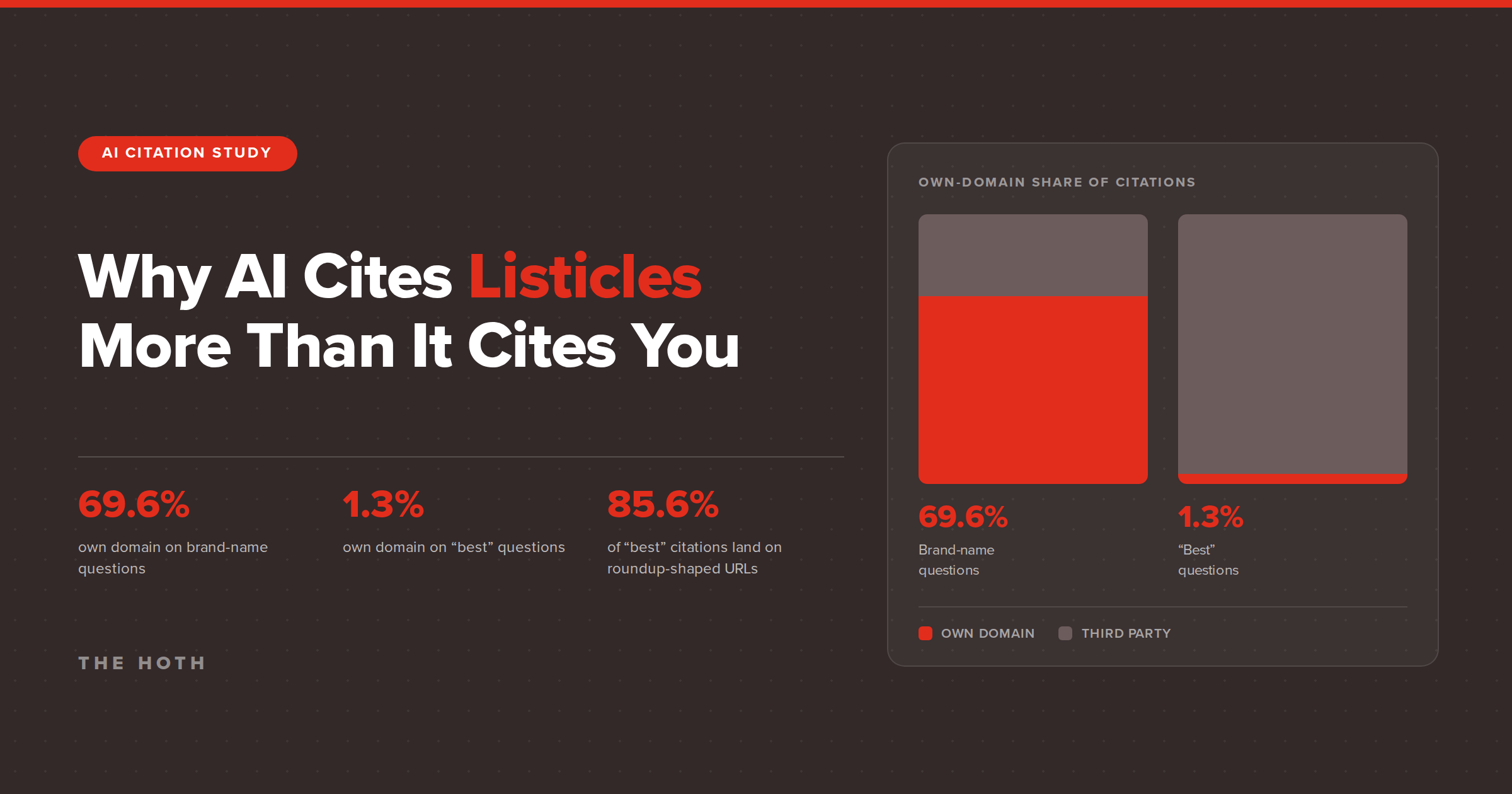

AI engines cite listicles more than they cite you because a “best X for Y” article is pre-structured comparison data with somebody else’s name on it. We pulled ChatGPT citation data for four brands and found that on questions naming the brand, 69.6% of citing responses pointed at the brand’s own domain. On questions containing the word “best,” that dropped to 1.3%.
There are two versions of your brand inside an AI answer, and you only control one of them.
Ask ChatGPT about your company by name and your own site does most of the talking. Your homepage, your product page, your “is this company legit” explainer. Ask ChatGPT for a recommendation in your category and your site nearly vanishes, replaced by somebody else’s roundup of the ten best options.
We measured how wide that gap gets. Using Ahrefs Brand Radar, we pulled ChatGPT citation data for four brands in August 2026 and sorted each brand’s citations into two buckets: responses to questions that named the brand, and responses to questions containing the word “best.” Then we classified every cited URL as brand-controlled or third party.
On brand-name questions, the brand’s own domain carried close to seven citations in ten. On recommendation questions, it carried closer to one in a hundred.
Same brands. Same engine. Same week. The only variable that changed was the question. That gap is the reason we sell listicle placements as a product instead of treating them as a content tactic, and it’s the reason your own “best of” post probably isn’t the fix you think it is.
Here’s what the data shows, where it stops, and what to do about it.
What Happens to Your Citations When Someone Asks for a Recommendation?
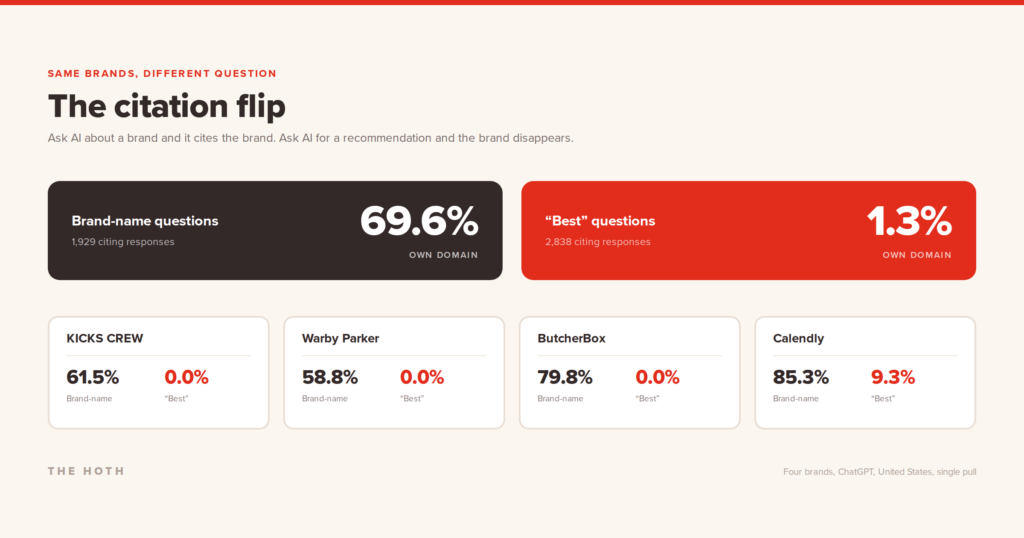
Your own domain stops being cited almost entirely. Across four brands, brand-name questions produced 1,929 citing responses and 69.6% of those cited the brand’s own site. “Best” questions produced 2,838 citing responses and only 1.3% cited the brand’s own site, a ratio of roughly 75 third-party citations for every one of your own.
The four brands were KICKS CREW, Warby Parker, ButcherBox, and Calendly. Three consumer brands, one B2B SaaS company. Brand-controlled meant the brand’s own registrable domain plus its branded help, support, and subscribe subdomains. Everything else counted as third party.
Here is how the split looked brand by brand.
| Brand | Own-domain share, brand-name questions | Own-domain share, “best” questions |
|---|---|---|
| KICKS CREW | 61.5% (352 of 572) | 0.0% (0 of 40) |
| Warby Parker | 58.8% (305 of 519) | 0.0% (0 of 1,925) |
| ButcherBox | 79.8% (424 of 531) | 0.0% (0 of 477) |
| Calendly | 85.3% (262 of 307) | 9.3% (37 of 396) |
Warby Parker is the clearest case. In the recommendation bucket it appeared in 1,925 citing responses and not one of them cited warbyparker.com. The three sources doing the talking instead were a Good Housekeeping piece on where to buy glasses online, cited in 205 responses, a Vision Center article on the best places to buy online at 129, and a Forbes roundup of the best online prescription eyeglasses at 117.
ButcherBox looked the same. Its top source in the recommendation bucket was a Good Housekeeping roundup of the best meat delivery services at 52 responses, followed by a Fortune piece at 35. Calendly’s top source was a TechRadar roundup of the best scheduling apps at 49 responses, ahead of calendly.com itself at 28.
Flip to the brand-name bucket and the picture inverts. KICKS CREW’s most-cited pages were its own: a page answering whether KICKS CREW is legit, cited in 33 responses, and its authenticity page at 28. Your site is good at answering questions about you. That’s a different job from being recommended.
The shape of the winning URL matters as much as the domain. In the “best” bucket, 85.6% of all citations landed on roundup or comparison shaped URLs, meaning the URL contained best, top, vs, alternatives, review, guide, comparison, where-to-buy, or places-to-buy. Narrow that to third-party citations only and the roundup share ran 90.5% for Warby Parker, 85.5% for Calendly, 74.6% for ButcherBox, and 60.0% for KICKS CREW.
So it isn’t that AI prefers other people’s websites in a general sense. It prefers a specific document type, and that document type is almost never something you publish.
What Can This Data Tell You, and What Can’t It?
It’s a directional read, not a census. The pull covers the top 30 to 50 cited pages per bucket for four brands, on ChatGPT, in the US, on a single date, with roundup classification done by URL pattern rather than manual review.
The limits are worth naming before you act on any of it.
- Top 30 to 50 cited pages per bucket, not every citation the engine produced.
- Roundup classification is a URL pattern heuristic. A comparison article on a URL that doesn’t use one of those words gets missed, and a page with “guide” in the slug gets counted even if it isn’t a roundup.
- ChatGPT only, US only, one pull date. Engines shift their retrieval behavior week to week.
- Four brands. Three consumer, one B2B SaaS. Not a sample you should generalize to every vertical.
- The brand bucket is a phrase match on the brand name. The “best” bucket is a phrase match on the word best, so a few queries in it use best incidentally rather than as a request for a recommendation.
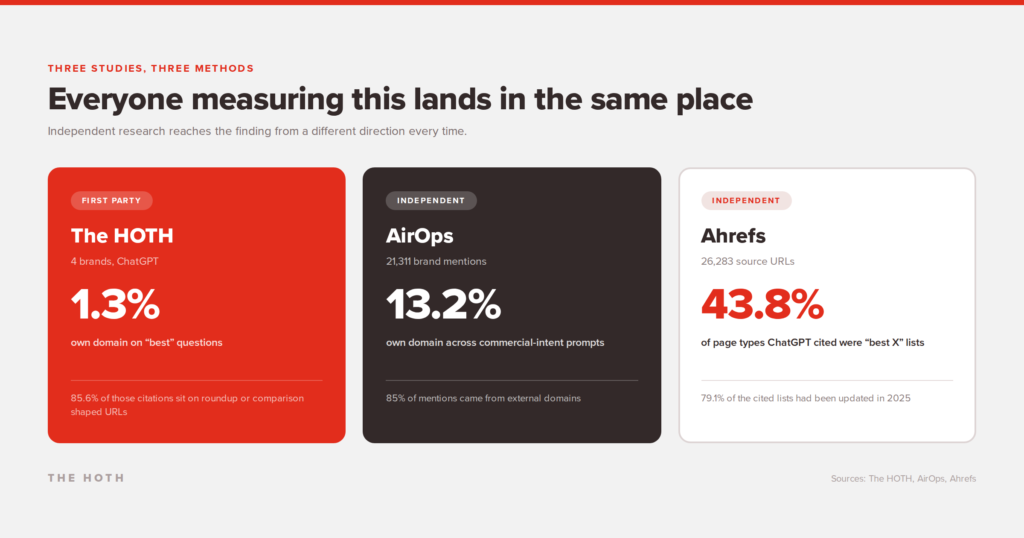
None of that moves the direction of the finding. A heuristic can shift 85.6% to 80% or 90%. It can’t turn 1.3% into a number that would make your own site the source of your category’s recommendations. And the pattern shows up in independent research that used different brands, different engines, and a different method.
Why Does the Pattern Flip So Hard on Recommendation Questions?
Because a recommendation is a comparison task, and the pages that already contain comparisons are roundups. Google’s own documentation describes AI features grounding answers in the Search index and fanning one question out into several concurrent sub-queries, which is how “best of” pages get pulled into answers where nobody typed the word best.
Google’s guide to optimizing for generative AI features describes two mechanisms that matter here. The first is retrieval-augmented generation, where the model grounds its answer in results pulled from the Search index rather than from memory. The second is query fan-out, where a single question generates multiple concurrent sub-queries.
Google’s own worked example is a homeowner asking how to fix a lawn full of weeds. The fan-out includes a sub-query for the best herbicides for lawns. The person never asked for a product recommendation. The system generated one anyway, and the pages that answer it are roundups.
That’s the part most brands miss. You don’t have to be losing recommendation queries to be losing recommendation queries. Plenty of informational questions in your category quietly route through a comparison sub-query on their way to an answer.
Ahrefs found the same document preference at scale. In a study of 750 top-of-funnel prompts covering 26,283 source URLs, “best X” blog lists made up 43.8% of all page types ChatGPT cited. They also found best lists were slightly more prominent in Google’s AI Overviews than in ChatGPT, so this isn’t one engine’s quirk.
There’s a credibility layer on top of the structural one. Your product page claiming you’re the best option is a claim. A publisher’s roundup saying it is evidence. Retrieval systems built to synthesize an answer from multiple sources are going to weight the second one higher, the same way a person would.
Do Other Studies Find the Same Split?
Yes, and at much larger scale. AirOps analyzed 21,311 brand mentions across more than 500 commercial-intent prompts and found 85% came from external domains against 13.2% from the brand’s own domain, with nearly 90% of those third-party mentions coming from listicles, comparisons, or reviews.
The AirOps report on the influence of offsite signals in AI search, published in October 2025, ran its prompts through GPT-5, Claude Sonnet 4.5, and Perplexity Sonar. Roughly 2% of mentions came with no citation at all. First-party share varied by engine: GPT-5 sat lowest at 4 to 11%, while Claude and Perplexity ran 13 to 21%.
Of the first-party mentions that did happen, product pages accounted for 19.3% and homepages for 7.1%. Your best-performing owned assets in AI search are the pages that describe what you sell, not the pages where you rank your competitors.
Our pull is that finding narrowed to the moment of recommendation. AirOps mixed commercial-intent prompts together. We isolated the “best” bucket and gave it a control: the same brands, the same engine, the same week, asked about by name. The 69.6% figure is what your own site is capable of when the question is about you. The 1.3% is what it drops to when the question is about your category.
We’ve made the broader case for earned coverage before, in our piece on how digital PR gets you cited in AI search. This is the narrower version of it: not just that independent sources win, but that one specific format of independent source wins most of the recommendation traffic, and that you can measure your exposure to it.
Should You Publish Your Own “Best Of” List?
It depends on what you sell. Ahrefs found a brand’s own blog list showed up in 34% of ChatGPT software responses and 17.2% of agency responses, but only 4% of product responses. Our pull matches that pattern almost exactly.
If you sell software or agency services, write the list. Ahrefs’ numbers say it earns you a share of answers, and it’s the one place where publishing your own comparison content pays off in AI citations.
Our data points the same way. Calendly, the only B2B SaaS brand in the set, was the only brand with any own-domain citations in the recommendation bucket at 9.3%. But look at what those citations were. Two URLs: the calendly.com homepage at 28 responses and calendly.com/scheduling at 9. Not a “best scheduling apps” post. Just the product, named.
If you sell products, the honest answer is that your own list does close to nothing. Ahrefs puts it at 4%. Our three consumer brands all returned zero own-domain citations in the recommendation bucket, including Warby Parker across 1,925 citing responses. Write the list if your audience wants it. Don’t build an AI visibility plan on it.
And in every category, including the ones where your own list works, your own list is not the thing putting you in the answer. Third-party roundups are, by a factor our data puts at roughly 75 to 1 on recommendation questions.
What Makes a Roundup Placement Worth Having?
Position, freshness, and spread. Brands placed higher in a list get recommended more often, recently updated lists get cited more often, and a mention on one platform is not the same as visibility in AI search.
Not every placement is worth the same, and the differences are measurable.
Position inside the list
Ahrefs found brands positioned higher in a list were recommended more often. AirOps found 80% of brands appeared within the first three companies discussed in a response. Two studies, different methods, same conclusion.
A mention at slot 14 of a list of 20 is not the same asset as a mention at slot 3. If you’re buying placements, the position you get is most of what you’re buying.
How recently the list was updated
Of 1,100 cited best lists in the Ahrefs set, 79.1% had been updated in 2025 and 26% within the previous two months. A roundup decays. A placement on a page nobody has touched in three years is worth less every quarter it sits there.
The publisher, but maybe not the way you’d guess
Ahrefs found 35% of cited best lists sat on low-authority domains. Relevance and structure carry more weight in this format than raw domain rating does. That’s good news if your budget doesn’t reach Forbes, and it’s why Vision Center outperformed Forbes in the Warby Parker pull.
How many publishers you’re on
AirOps found 68% of brands appeared on only one platform. One placement, on one publisher, read by one engine, is a single point of failure. Breadth is the fix, which is the job Earned Media is built for, while Exclusive Media Links raises the authority ceiling on which publishers are willing to pick you up in the first place.
All four of those factors are why our Listicles product is built the way it is: prominent placement, usually in the top half, with a specific angle such as best for a named use case, and placements spaced across publishers rather than published all at once. You can see how off-page work compounds across channels in our client case studies.
Where Is the Line Between an Editorial Placement and Spam?
The line is purpose. Google’s spam policies say third-party content on a host site is not a violation by itself, and becomes site reputation abuse only when the content is published mainly to exploit the host’s established ranking signals rather than to reach the host’s readers.
It’s worth taking Google’s own warning seriously here. The same generative AI guide that explains fan-out also says that seeking inauthentic mentions across the web is not as helpful as it seems. That’s a real caution, not a formality, and it describes exactly what buying your way into 200 low-quality lists looks like.
But the policy itself is more specific than the caution. Google’s spam policies define site reputation abuse as third-party content published primarily because the host site ranks well, with little oversight or involvement from that host. The same document is explicit that editorial content, columns, and advertorial where the purpose is reaching the publisher’s readers are not site reputation abuse.
So there’s a question you can ask about any placement: would this article exist and be useful to readers if your link weren’t in it?
A Good Housekeeping roundup of meat delivery services passes that test. It’s useful with or without ButcherBox in it. That’s why it earns citations, and why a placement in it is worth something. A page assembled to host links fails the test, and it fails it for AI engines the same way it fails for Google.
In practice that means a freshly written original article with a real publisher and a real editorial angle, with competitors named and treated fairly, and at least one genuine third-party source cited for authority. Not an insertion into an existing page built to sell link slots.
How Do You Get Into Other People’s Roundups?
Start by pulling the roundups AI already cites in your category, then work the gaps. The target list comes from citation data, not from a PR wish list, and it’s usually shorter and stranger than the publications you’d have guessed.
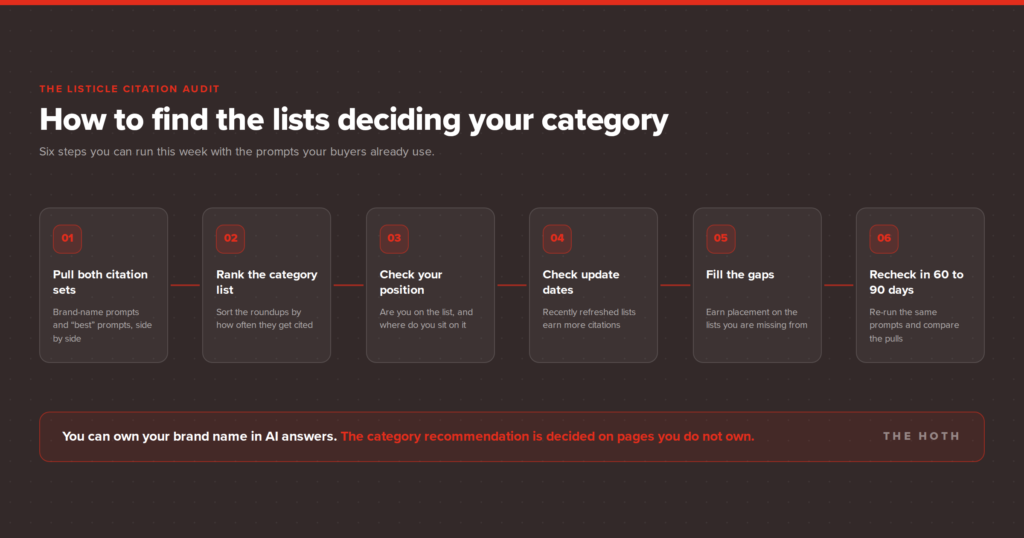
- Pull both citation sets. Run brand-name prompts and “best [your category]” prompts, and record which URLs get cited on each. Brand Radar automates it. Manual testing across 20 to 30 prompts works if you don’t have the tooling. You’re building two lists: the pages that carry your name and the pages that carry your category.
- Rank the category list by citation frequency. That ranking is your target list. It will not match your PR wish list. Vision Center beating Forbes is the normal result, not the exception.
- Check your position on the ones you’re already in. If you’re in a cited roundup at slot 12, the fix is an outreach and update conversation with that publisher. That’s a different job from not being in the list at all.
- Check the update dates. A cited roundup you’re in that hasn’t been touched since 2023 is a maintenance opportunity. It’s earning citations now and it won’t forever.
- Fill the gaps with new placements. Our Listicles product runs $450 for a single placement or $2,250 for a five-pack. Each one is a freshly written original “best of” article of around 1,000 words with a real publisher, not an insertion into existing content. Turnaround is 4 to 6 weeks and the link is guaranteed for a year. Your dofollow link is the only brand link in the piece. Competitors get named and treated fairly, they just don’t get links.
- Recheck in 60 to 90 days. Citation behavior moves. Treat your target list as something you re-pull each quarter rather than a one-time audit.
One note on exclusions. We honor exclusion lists, but we don’t remove category leaders from a piece, because a roundup that omits the obvious market leader reads like an advertisement to a human editor and gets treated like one by a retrieval system. The credibility of the format is the thing you’re buying. Break it and the placement stops working.
This fits ecommerce and DTC, SaaS and tech, local and service businesses, B2B, and agencies buying for clients. For how it connects to everything else, start with our AI search visibility hub.
What Else Do Brands Ask About AI Citations and Listicles?
The recurring questions are whether listicles really beat product pages, whether your own “best of” list is worth writing, whether the publisher’s authority decides the outcome, and whether paid placements break Google’s guidelines. Short answers to each, all of them grounded in the data above rather than in assumptions about how the engines work.
Does AI really cite listicles more than product pages?
For recommendation questions, yes, by a wide margin. In our pull, 85.6% of citations on “best” questions landed on roundup or comparison shaped URLs. AirOps found nearly 90% of third-party brand mentions came from listicles, comparisons, or reviews. Product pages do carry weight, but mostly on questions that already name your brand.
Will writing my own “best of” list get me cited by ChatGPT?
If you sell software or agency services, sometimes. Ahrefs measured own-brand lists showing up in 34% of software responses and 17.2% of agency responses. If you sell products, expect close to nothing: 4% in the Ahrefs data, and zero own-domain citations across all three product brands in our pull.
Do I need a high-authority publisher for a placement to count?
Not necessarily. Ahrefs found 35% of cited best lists sat on low-authority domains, and in our Warby Parker data a niche vision site out-cited Forbes. Topical relevance and clear comparison structure matter more in this format than domain rating alone.
Is paying for a listicle placement against Google’s guidelines?
Third-party content on a host site is not a violation by itself under Google’s spam policies. It becomes site reputation abuse when content is published mainly to exploit the host’s ranking signals with little oversight from the host. Editorial and advertorial content published to reach the publisher’s readers is named in the policy as not being site reputation abuse. The test is whether the article would be useful without your link in it.
How long does it take for a placement to show up in AI answers?
We don’t have a first-party number for time to citation and won’t invent one. What we can say is that publication takes 4 to 6 weeks on our Listicles product, and the engine then has to crawl and retrieve the page. Ahrefs’ freshness data, where 26% of cited lists had been updated within two months, suggests recency helps. Re-pull your citation data 60 to 90 days after publication and measure it.
How is this different from digital PR?
Digital PR is the broader practice of earning coverage and mentions across independent sites. Listicle placements are one format inside that, aimed specifically at the comparison pages AI engines lean on for recommendations. Most brands need both. This post is about why the format is worth isolating and budgeting for on its own.
So Where Does This Leave Your Content Plan?
Your own site can win your own name, and for most brands it already does at close to seven citations in ten. The category recommendation is settled somewhere else, on pages you don’t own and can’t optimize, so any serious AI visibility plan has to include getting onto them.
That’s the split this whole post is about. One half of your AI presence is a content problem you can solve on your own domain, and most brands are already solving it. The other half is a distribution problem living on somebody else’s domain, and no amount of on-site work touches it.
Pull your citation data first and see how exposed you are. If the roundups deciding your category don’t have your name in them, book a call and we’ll go through the target list with you.
Leave a comment