

The agency survival question is what a client asks when the rankings hold and the pipeline does not: what exactly am I paying you for? Answering it means changing what your retainer delivers, moving from positions on a results page to presence inside the answers your client’s buyers are reading instead.
You have run the account for two years. Rankings are up. Nothing on the report is red. Then the client opens the call by saying lead volume is soft and asking, in a tone you have not heard from them before, what they are paying for.
Nothing in your delivery broke. What broke is the connection between the number on your report and the outcome your client feels in their business.
That gap is the whole problem, and it is coming for every agency that sells search. Not as a sudden collapse, but as a slow erosion in renewal conversations that used to be easy.
This is a piece about your business rather than your pitch. If you want the script for the client meeting itself, our guide to selling AI visibility to your clients covers the diagnosis, the scope, and the objections. What follows is about the layer underneath that: your reporting, your pricing, your positioning, and which accounts to move first. If you already run a white label program, it is also about which parts of your catalog are about to stop earning their place.
What is the agency survival question?
It is the moment a client stops treating rankings as proof and asks what the retainer is buying. The question is rarely about your work quality. It is about a deliverable that quietly stopped matching the outcome the client cares about.
Every agency model runs on a proof metric. It is the number you put on the report each month that stands in for the thing the client really wants, which is revenue. For roughly two decades in search, that number was position.
Position was a good proxy because position produced clicks, and clicks produced business. The proxy was never the product. It was a reliable shortcut to the product, and it held for long enough that most of the industry forgot it was a shortcut at all. When a proxy stops tracking the thing it stands in for, you are no longer selling an outcome. You are selling a number, and clients tolerate that for a while and then stop.
The clearest tell is churn while performance is fine. If your rankings are flat or improving across the book and renewal conversations are getting harder anyway, that combination is diagnostic. It means the report is no longer doing the job the report exists to do.
Worth saying plainly: the client is not being unreasonable. They can open ChatGPT themselves, ask who the best provider in their category is, and watch three competitors get named. That takes eleven seconds and no marketing knowledge. You are not going to argue them out of what they saw.
Why did the retainer math stop working?
Because the ranking and the visit came apart. A position your report tracks now often sits behind an answer the buyer reads without clicking, so your metric and your client’s revenue no longer move in the same direction at the same speed.
The infrastructure data makes this concrete in a way agency commentary does not. Cloudflare publishes a crawl-to-refer ratio on Radar, which divides the pages a platform’s crawler requests by the referrals that platform sends back. In its writeup of the metric, Cloudflare reports that for the week of June 19 to 26, 2025, the ratios ran from roughly 70,900 pages requested per referral at one end down to Mistral, which sent more referrals than it made crawl requests.
Cloudflare’s framing of what changed is the part that matters for your business. Legacy search crawlers scanned a site a small number of times for each visitor they sent, which is why letting them in was good for revenue. The newer pattern is more crawling with the same or less traffic returned. Cloudflare also notes a real caveat: traffic from native apps often arrives without a referrer header, so the published ratios may overstate the imbalance by an unknown amount. Even with that caveat, the direction is not in dispute. Your client’s content is being read at scale by systems under no obligation to send anyone back to the page it came from.
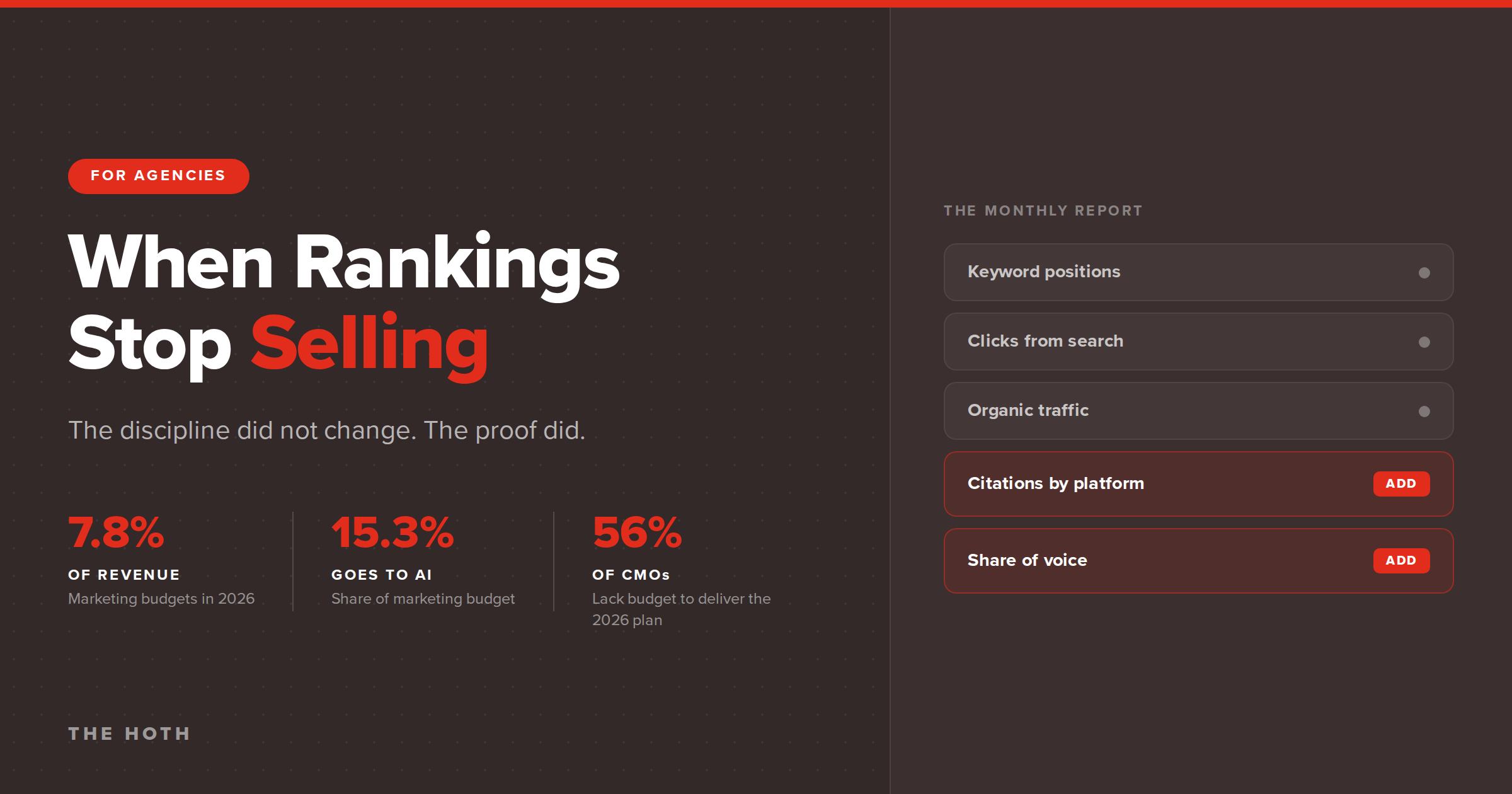
Now the money side, which is where it stops being an interesting industry trend and starts being your P&L. The Gartner 2026 CMO Spend Survey found marketing budgets effectively flat, edging from 7.7 percent of company revenue in 2025 to 7.8 percent in 2026, while 15.3 percent of marketing budgets went to AI initiatives and 56 percent of CMOs said they lacked the budget to deliver their 2026 strategy.
Read the sample carefully before you use it. Gartner surveyed 401 marketing leaders between January and March 2026, the vast majority at companies above a billion dollars in revenue. That is not your local HVAC client. Treat the percentages as directional rather than as a benchmark for a book of small business accounts.
The mechanism transfers even where the numbers do not. Budgets are not expanding to accommodate AI work. The money is being reallocated from something else, and in a marketing budget the something else is frequently the search line.
So here is the sentence to sit with. If a line item for AI visibility shows up in your client’s budget this year, it came out of another line. If you were not the person who put it there, someone else was, and that someone now has a reason to look at the rest of the account.
What changed, and what did not?
The surface changed and the measurement changed. The underlying discipline did not. Google’s own documentation says optimizing for its generative AI features is still SEO, which means most of what your team already does well continues to count.
This is the part the panic coverage skips, and it is the most useful thing an agency owner can know right now. Google’s guide to optimizing for generative AI features addresses the AEO and GEO labels directly and says that from Google Search’s perspective, optimizing for generative AI search is optimizing for search, because those features are grounded in the same ranking and quality systems that already existed.
The guide goes further and lists things you can ignore for Google Search. Special machine-readable files such as llms.txt are not used. Breaking content into small chunks is not required. Rewriting pages specifically for AI systems is unnecessary because those systems understand synonyms and intent. Chasing inauthentic mentions across the web is less useful than it sounds. Structured data is worth keeping as part of general SEO but is not a requirement for generative AI search.
What Google says matters most is content that is unique and non-commodity, the sort that carries a point of view or first-hand experience rather than restating common knowledge. It states that this will likely influence a site’s presence in generative AI search more than any other suggestion in the guide. For measurement, it points to the generative AI performance report in Search Console, and it warns against third-party tools that claim access to internal Google ranking metrics.
Two implications for an agency owner, and they pull in opposite directions. The first is relief: you do not need to rebuild your agency around a new discipline, retrain your team, or apologize for the last five years of work. The foundation you already sell is still the foundation.
The second is a warning. A meaningful share of the AEO products being marketed to agencies right now are priced against work that Google states plainly does nothing for Google Search. If you resell one of those under your own brand, you will be the one defending it in a renewal meeting twelve months from now, not the vendor who sold it to you.
Do not overread the guidance either. Google speaks for Google. ChatGPT, Perplexity, Gemini, and Claude do not share Google’s index, and Google’s documentation is not a description of how they behave. The part that generalizes across all of them is third-party validation: editorial coverage on publications a model already treats as credible, a review profile that reads well, and content current enough to be worth retrieving.
None of that is a new skill set. It is earned media, digital PR, review and reputation management, and content refresh. Your agency either sells those already or outsources them already. The change is in what you claim they produce and how you prove it.
What breaks first inside your agency?
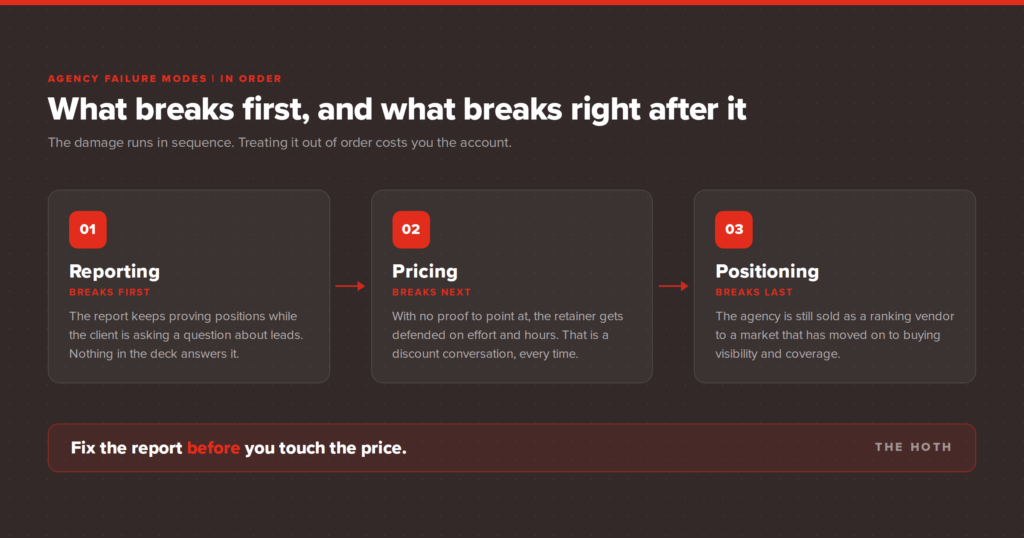
Reporting breaks first, then pricing, then positioning. The monthly report stops proving value before the work stops producing it, which is why accounts churn while the rankings still look fine.
These three fail in a predictable order, and knowing the order tells you what to fix first.
Reporting breaks first
Your monthly report is retention collateral before it is a deliverable. It is the artifact that sits in the client’s inbox and answers the renewal question before the renewal conversation happens.
A report that shows only position describes a world your client no longer lives in. They are getting screenshots from their sales team of AI answers naming competitors, and your document has nothing to say about it. The silence reads as either ignorance or avoidance, and neither helps you.
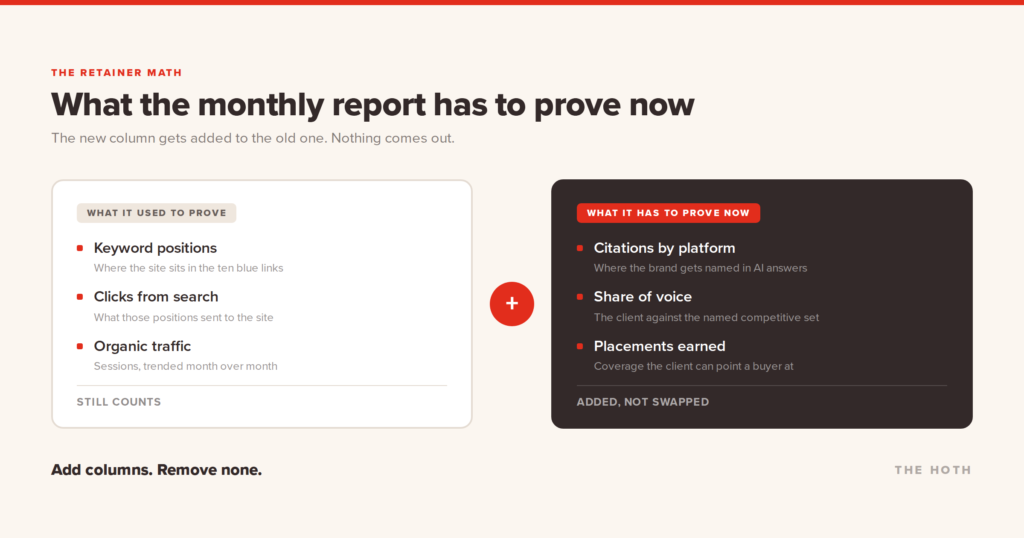
The fix is additive rather than a replacement. Keep the rankings. Add citation counts broken out by platform, and share of voice against a named competitor set run on a consistent prompt list. Rankings stay on the page. They just stop being the only column.
Pricing breaks second
Per-unit pricing takes the hit next, for structural reasons that have nothing to do with AI. A link is countable, so it is comparable, so it gets price-shopped. When the client is already questioning whether the category works, a countable deliverable is the easiest thing in the world to cut in half.
Program pricing survives that conversation because there is no unit to halve. If you have not made that shift yet, our breakdown of SEO reseller packages and what they cost covers the wholesale math, and the SEO retainer guide covers the structural move from project work to recurring revenue.
Positioning breaks last, and costs the most
This one is slow and quiet. If your website, your capabilities deck, and your proposal template all describe an agency that does SEO and improves rankings, you are being screened out of deals before anyone reaches out. You never see those losses, which is exactly why the problem persists for years.
Order matters here. Fix the report before you touch the price. A price increase without new evidence is a request for trust you have not earned yet this quarter, and it lands as opportunism even when it is justified.
What do the durable agencies sell instead?
They sell presence and proof: editorial coverage the client can see, reputation signals, current content, and a monthly report that tracks citations and share of voice alongside positions. The tactics are familiar. The framing and the evidence are not.
The reassuring part is how much of this you already do. The work that earns AI citations is largely the work that earned rankings, pointed at a wider set of destinations and reported differently.
A packing and moving service running a link building campaign in a competitive local market is a clean example. The campaign built 210 backlinks from 39 referring domains, deliberately spreading placements onto service pages such as piano moving and packing rather than overloading the core location pages. Organic traffic value rose 39 percent to 12.6 thousand dollars, 21 new keywords landed in the top three, and citations appeared across AI platforms as a byproduct of the same work.
Nobody on that campaign bought an AEO product. They bought authority, and the authority paid on two surfaces instead of one. That is the offer in a sentence.
So you are not adding a service line. You are widening the reporting on the line you already have and pricing it for what it now demonstrably produces.
On the fulfillment side, the components are ordinary: Exclusive Media Links and earned media for the publisher footprint, content refresh for pages that have gone stale, and review work for the reputation signals that feed local recommendations. If you would rather buy the whole program under one number and one strategist instead of assembling it, AI Discover bundles those channels with citation tracking, and Managed SEO covers Google and AI together under a single monthly scope.
How do you rebuild the offer without losing the book you have?
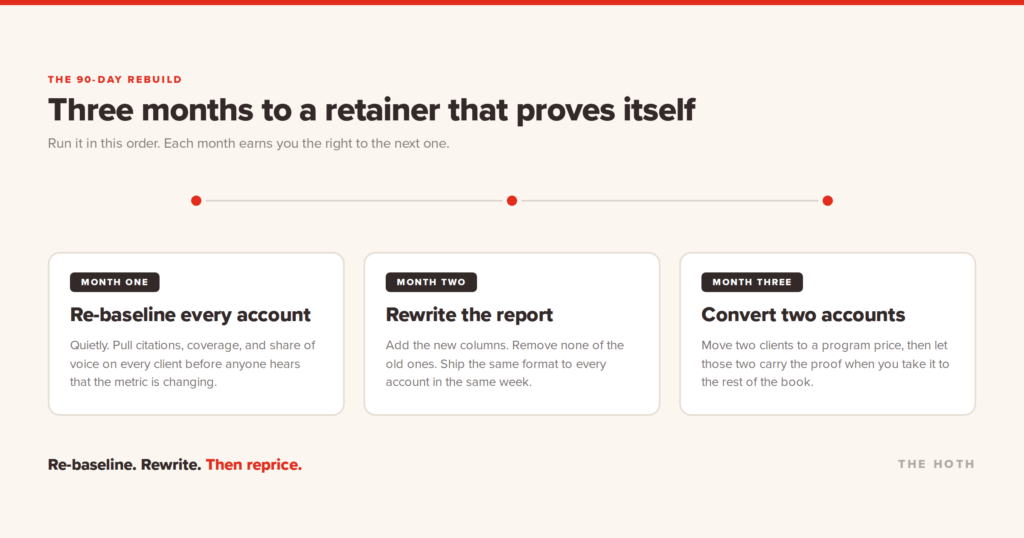
Run it across one quarter in three moves: re-baseline every account, rewrite the report before you rewrite the price, and convert one or two accounts to a program price so you have your own proof before you take it to the rest.
The failure mode here is trying to do it everywhere at once. Announcing a new positioning and a new price to your whole book in the same month invites every client to reopen every term simultaneously. Sequence it instead.
Month one: re-baseline quietly
Pull a citation and coverage baseline for every active account. Not to sell anything yet. To know where you stand before a client asks you a question you cannot answer.
You will find two groups. Some clients are already being named in AI answers, usually the ones with real editorial coverage and a healthy review profile. Those accounts need defending and give you an easy, positive conversation. Other clients are absent entirely. Those are the accounts at risk, and they are also your clearest expansion opportunities.
Do this before a client does it for you. Walking into a call already holding the answer is a completely different meeting from reacting to a screenshot.
Month two: rewrite the report
Add columns, remove nothing. Citations by platform, share of voice against named competitors, placements earned with the publication and date, and the rankings you have always shown.
Include one line explaining that analytics will undercount AI-driven traffic, because many AI platforms do not consistently pass referrer data and those visits land as direct traffic. Put that line in the first report rather than the fifth. A report that anticipates its own gap reads as competence. The same disclosure delivered in month five, after the client spots the discrepancy, reads as a cover story.
Month three: convert two accounts
Two, not twenty. Choose for tolerance and for evidence: a client who trusts you and an account where you can show movement inside a quarter. Move them to a single program price, run one full quarter, and use the result as the internal case study you take to everyone else.
A regional ad agency that joined The HOTH’s white label program in 2018 ran a version of this sequence, and the detail worth noticing is that they were never an SEO shop to begin with. They did web design, logo design, and video production. They placed a single Link Outreach order for one domain, added a managed SEO campaign about five months later, and by year five were running results for more than 28 client domains with a 2x year-over-year increase in net income. Their clients saw a 150 percent increase in online visibility, twice the leads, and a 135 percent increase in sales.
The numbers are the headline, but the sequencing is the lesson. One product, one client, proof, then expansion. They never rebuilt the agency. They changed what the agency bought.
Which agencies do not make it through this?
The ones that keep selling a metric their clients stopped believing, and the ones that overcorrect into promises they cannot deliver. Both fail the same way: the offer stops matching what the client is able to verify.
There are two ditches on this road, and the second catches more people than the first. The first is standing still. Ranking-only reporting, per-unit pricing, and a website that has not changed since 2021. This agency does not lose clients dramatically. It loses one at each renewal, always for a reason that sounds specific and never is.
The second ditch is overcorrection: rebranding overnight as an AI visibility agency, promising citations on named prompts, and repeating vendor language nobody in the building fully understands. This feels like momentum for about two quarters. It breaks in month seven, when the client asks for the specific citation they were promised and the model has moved on without asking anyone’s permission.
The honest middle is narrower and much more durable. Commit to the work, the volume of placements, and the reporting. Refuse to commit to what a given model says on a given day, and say out loud that any agency promising otherwise is guessing. Clients respect that more than a number you will have to walk back.
The agencies that come through this are the ones that hold the client relationship and stay flexible about everything underneath it. The relationship is the durable asset. Fulfillment is a supply chain decision, and supply chain decisions are supposed to change.
Should you build the capability or partner for it?
Partner first if the capability is not already in the building, because what moves AI visibility is editorial relationships and sustained monthly volume, and neither of those can be hired into existence inside a quarter.
Be precise about the split, because it is the same conversation your clients are having about you. Some of this work is reachable for a competent in-house team. Cleaning up site structure, keeping key pages current, asking customers for reviews, and making sure the technical fundamentals hold are all doable with the people you have. Admitting that makes the rest of your answer credible.
What is not reachable on a short timeline is the piece that moves the needle: earning placements on publications that AI systems already treat as credible. That runs on relationships with editors, and relationships take years. The second unreachable piece is endurance. This is monthly placement volume, quarterly content work, and continuous review generation, tracked across four or five platforms that each behave differently. Most teams start that and stop by month three.
The white label route exists precisely because that gap is expensive to close. You keep the client, the pricing, and the brand on every report. The HOTH reseller program provides wholesale pricing, an unbranded dashboard, and campaign managers who never identify themselves to your client. For a product-by-product view of what layers into existing accounts most easily, see our rundown of the easiest HOTH products to resell.
If you want proof to bring into a specific vertical conversation, the case study library is organized by industry and outcome, and several of the recent entries include AI citation data alongside the traditional metrics.
Frequently asked questions
Is SEO dead?
No, and framing it that way will cost you credibility with clients who can tell the difference. Google states that its generative AI features are grounded in the same ranking and quality systems as the rest of search, so the foundational work still applies. What changed is that rankings alone no longer prove the outcome, which means rankings alone can no longer carry your reporting.
Do I need to add an AEO service line to my agency?
Not as a separate discipline. Most agencies need broader reporting on the authority work they already sell, plus more emphasis on the channels that produce third-party validation. Packaging it as a distinct offering for sales reasons is fine, as long as the fulfillment underneath is real work rather than tactics that do nothing.
How do I answer a client who says their competitor shows up in ChatGPT and they do not?
Tell them AI answers are assembled from sources the system already trusts rather than ranked from a list, and that what other publications say about a brand carries more weight than what the brand says about itself. Then run the prompts live on a shared screen and log who gets named. The demonstration does more work than the explanation.
What can I promise, and what should I refuse to promise?
You can promise a documented baseline, a defined volume of placements and content work, and consistent monthly reporting. Refuse to promise a citation on a specific prompt, permanence of any citation, or a fixed citation count. Those depend on model behavior nobody controls.
How long does it take to see movement in AI visibility?
Expect a documented baseline in month one, early movement in roughly 60 to 90 days on lower-competition prompts, and meaningful volume across multiple platforms somewhere in months three to six. Competitive categories and low starting authority push that out.
My clients are small local businesses. Does any of this apply?
Yes, and often faster, because the competitive set is smaller. Local AI recommendations lean heavily on review volume, recency, response rate, and listing accuracy, which makes review and reputation work the most direct lever for a local account. The enterprise budget data does not describe your clients, but the shift in where buyers get their shortlist does.
Answering the question before it gets asked
The agencies that come out of this in good shape will not be the ones with the best explanation of how language models work. Clients do not buy explanations. They will be the agencies that re-baselined their accounts before a client asked, rewrote the report before rewriting the price, and can point at something specific when the survival question comes up. Which it will, on a call you were not expecting, probably about an account you thought was safe.
Look at your three largest accounts this week. For each one, ask whether the report you sent last month would survive that question. If the answer is no for even one of them, that is the work for this quarter.
If you want help mapping this against a specific client mix, book a call and we will go through your current offering, which accounts to move first, and what the fulfillment looks like under your brand.
Leave a comment