
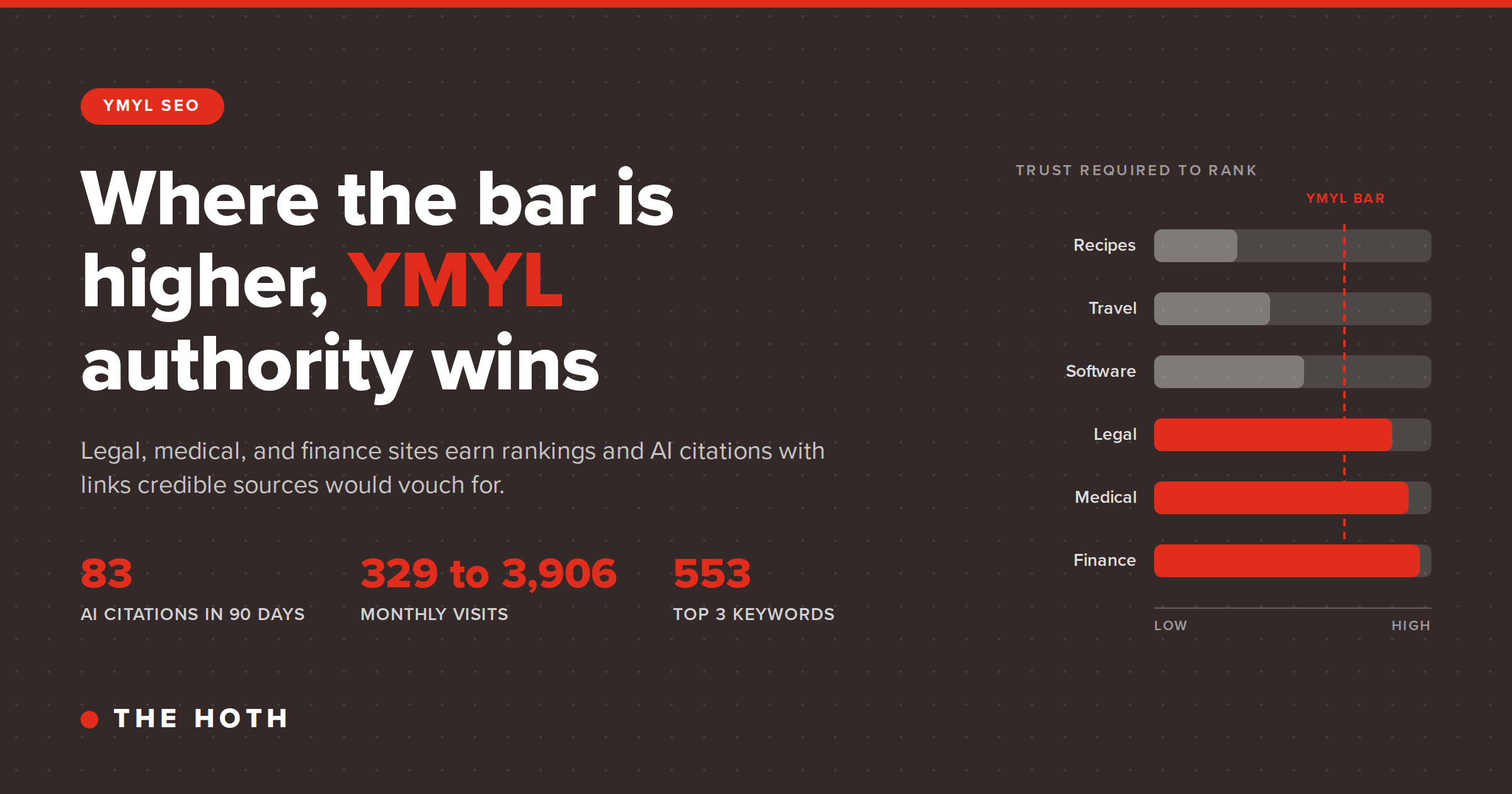

YMYL, short for Your Money or Your Life, is the label Google uses for topics that can affect a person’s health, finances, safety, or welfare, and it covers most legal, medical, and financial websites. YMYL SEO is the work of proving your authority to search engines and AI assistants that apply a stricter standard to these topics before they rank or cite you. Across our campaigns, the proof that clears that bar is earned authority, meaning editorial links and mentions from credible sources, rather than content volume.
If you run a law firm, a clinic, a lender, or any business that touches someone’s health or money, you already know the feeling. You publish accurate, careful content. Your competitors publish more of it. And somewhere inside Google’s systems, and inside the answers ChatGPT gives your prospects, a scale tips against both of you for reasons nobody spells out.
The reason has a name. Google groups legal, medical, and financial topics under YMYL and holds them to a higher standard than a recipe or a product review. AI assistants inherit the same caution, and Google says as much in its own documentation for site owners.
This post is the field guide we wish every YMYL client had before they signed up. It defines the standard, explains what the higher bar looks like in practice, and walks through three campaigns (a motorcycle accident law firm, an at-home medical testing brand, and a consumer lender) that earned rankings and AI citations in the most scrutinized categories on the web. It closes with the playbook we run inside HOTH X for YMYL accounts.
What is YMYL, and why does it carry a higher bar?
YMYL topics are the ones where a wrong answer can hurt someone: medical advice, legal information, financial decisions, safety, and civic information. Google’s Search Quality Rater Guidelines instruct raters to apply very high page quality standards to these topics, which means the E-E-A-T signals that are nice to have elsewhere are the price of entry here.
Google publishes an overview of its rater program, and the Search Quality Rater Guidelines overview is unusually plain about what changes for YMYL. Raters evaluate every page on Experience, Expertise, Authoritativeness, and Trust, then apply a much stricter version of that test when the topic could affect someone’s health, financial stability, or safety. The document’s own example is a page about influenza: because the topic can significantly impact a person’s health, it is YMYL, and it only earns the highest rating if it sits on a medical site with a very positive reputation for that topic.
Two details matter for anyone doing SEO in these industries. First, raters do not rank pages. Their scores are aggregated and used to test and train Google’s automated systems, so the guidelines describe what the algorithm is being taught to reward. Second, the same document explains how those systems understand quality in the first place: through signals, and its lead example of a signal is the number of quality pages linking to a page.
Put those together and the YMYL problem becomes concrete. Google is training its ranking systems to demand very high E-E-A-T for legal, medical, and financial topics, and one of the primary ways those systems read E-E-A-T is by looking at who vouches for you. We covered the rater document in depth in our guide to Google’s search quality guidelines and the framework itself in our post on the E-E-A-T update, so this post stays focused on what the standard means once AI systems start answering the question.
Why does YMYL matter more now that AI answers the question first?
People now ask ChatGPT, Google’s AI Overviews and AI Mode, and Perplexity their legal, medical, and financial questions before they ever see a search result, and those systems answer by retrieving and citing a small set of sources they trust. For a YMYL site, that turns a ranking problem into a citation problem, and the sources that get cited are the ones with verifiable authority.
Google’s guide to optimizing for generative AI features removes most of the mystery about how this works on its own surfaces. AI Overviews and AI Mode are rooted in the core Search ranking and quality systems. They use retrieval-augmented generation to pull pages from the Search index, fan the question out into related queries, and then cite the pages that support the answer. There is no separate AI index and no separate quality bar. If your page would not be trusted for a YMYL query in classic search, it will not be retrieved for the AI answer either.
The reason answer engines lean so hard on retrieval in these categories is that the models on their own are not reliable on the facts. A peer-reviewed study from Stanford’s RegLab, Large Legal Fictions, asked large language models specific, verifiable questions about federal court cases and found hallucination rates between 69% and 88% depending on the model. That research measured 2023-era models, and the systems have improved since, but the design lesson stuck: for legal, medical, and financial questions, AI products ground their answers in sources they can point to.
That is the opening for a YMYL brand. When a prospect asks an AI assistant whether they need a workers’ comp lawyer, what a liver panel measures, or how a personal loan affects their credit, the system has to cite someone. In our experience the winners are not the sites with the most pages on the topic. They are the sites that already look trustworthy to Google’s classic systems, because that is the pool the AI features draw from. We explored the mechanics in why E-E-A-T still matters in generative search, and our 12-month campaign review, there was no AI-specific hack, reached the same conclusion across every vertical we tracked.
Why do most YMYL SEO strategies stall?
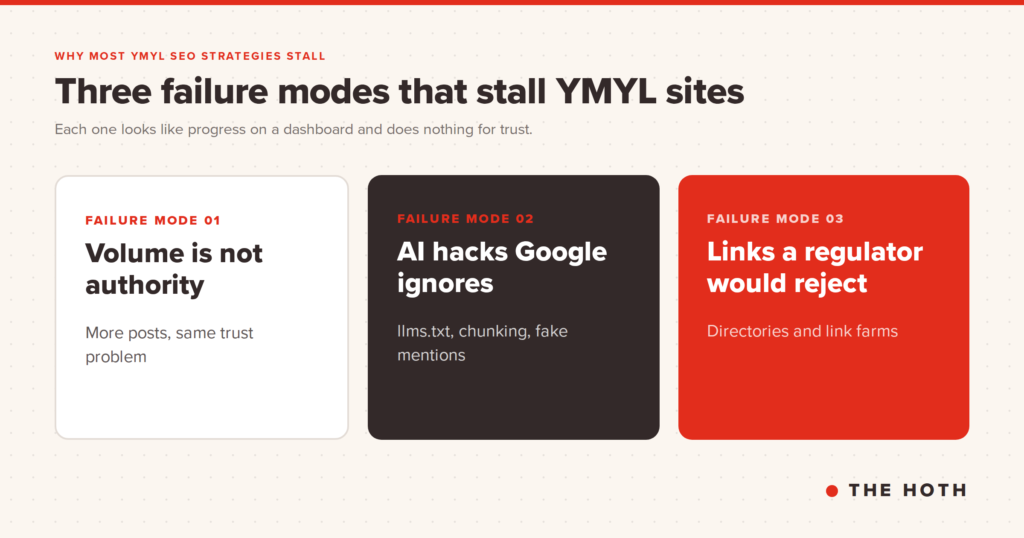
Most YMYL sites stall for one of three reasons: they treat content volume as authority, they chase AI-specific tactics that Google says it ignores, or they build links that an editor or a regulator would never endorse. All three produce activity without producing trust.
Volume is not authority. The motorcycle accident firm you will meet in the next section was already publishing excellent legal blogs in-house when they came to us. Their content was not the problem. Their backlink profile had nothing in it that told an algorithm or a language model “this is a trusted motorcycle injury authority.” Adding a fourth blog a week would not have fixed that.
AI hacks do not work on Google, and Google has said so. The same generative AI guide includes a section on what you do not need to do. It lists LLMS.txt files and other special markup, “chunking” content into tiny pieces, rewriting copy just for AI systems, and seeking inauthentic mentions across the web, and states plainly that Google Search does not use them. For a YMYL site with a limited budget, every dollar spent on those tactics is a dollar not spent on the signals the rater guidelines describe.
Bad links are worse in YMYL than anywhere else. Legal and medical sites are scrutinized closely, and the guidelines’ emphasis on reputation cuts both ways. A hundred directory listings and a handful of links from sites that would never pass an editor do not move a law firm. One placement on a bar association site, a rider safety organization, or a local news outlet does. We covered the specifics of this in our guide to link building for lawyers, and the principle holds for every YMYL vertical.
What earned a law firm 83 AI citations in 90 days?
A law firm specializing in motorcycle accidents earned 83 new AI citations, 2,500 additional monthly organic visitors, and a 138% increase in top-3 keywords in 90 days by adding editorial authority to content the firm was already producing well. The strategy was digital PR and targeted link outreach to legal, motorcycle safety, and rider advocacy sites, with every placement reinforcing one narrative about the firm’s expertise.
The firm operates in a major metro area stacked with personal injury practices pouring money into SEO, AI search, and paid ads. Even with a narrow focus on motorcycle accidents, they faced ruthless competition, and as a YMYL site they also faced the extra layer of scrutiny that comes with legal topics.
Our team built the campaign around digital PR and link outreach. We targeted placements on trusted legal, motorcycle safety, and rider advocacy websites, pursued industry roundups and “best personal injury attorneys” lists, and supported that with contextual links from biker forums, safety blogs, and local news. Link insertions went to the homepage and service pages where they made sense. Links were spread across the homepage, primary service pages, and blog posts so no single page looked over-optimized.
The detail that mattered most was consistency. Every placement carried a distinct narrative that reinforced the firm’s expertise in motorcycle injury cases, so AI systems could connect the mentions rather than treating them as scattered signals.
Over three months, the firm added 2,500 monthly organic visitors, grew top-3 keywords by 138% (18 new terms), and now ranks #1 for transactional queries like “motorcycle injury attorney Georgia.” On the AI side, they acquired 83 new citations from platforms including ChatGPT and Perplexity in the same 90 days. The full write-up is on our law firm 90-day case study.
It is not an isolated result. Across our legal library, one firm grew from 500 to 7,000 monthly visitors, another earned 800% more backlinks, an employment law firm grew traffic 1,000%, and a firm hit by a Google update recovered with a 334% traffic increase in six months. The pattern is the same each time: authority beats content volume for YMYL legal sites. Our complete law firm SEO guide walks through the full playbook.
How did a medical testing brand go from 329 to 3,906 monthly visits?
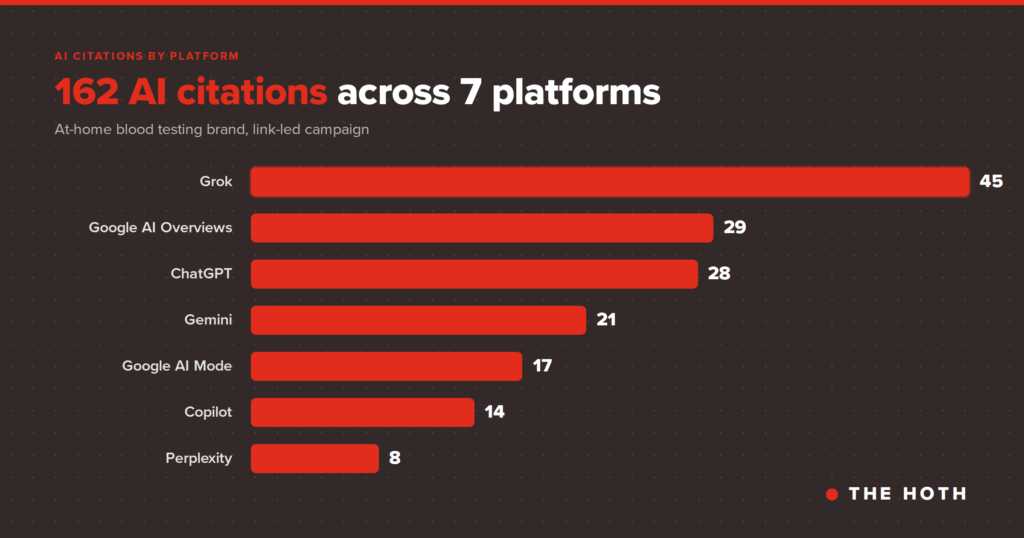
An at-home blood testing company grew organic traffic from 329 to 3,906 monthly visits, moved from 10 to 233 top-3 keywords, and earned 162 AI citations across seven platforms with a campaign built almost entirely on earned authority: Exclusive Media Links, Platinum Links, and outreach to sites rated DR 20 and above. Health is the category where AI systems are most careful about who they cite, and the single most valuable placement was the #1 AI Overview slot for “at home liver test.”
Consumer health is arguably the hardest YMYL category. The rater guidelines’ flagship example of a YMYL topic is a medical page, and AI assistants hedge heavily on health questions. This client sold diagnostic tests people run on themselves at home, which puts every page they publish squarely inside that scrutiny.
The campaign was deliberately link-led. Rather than flooding the site with new content, we focused on Exclusive Media Links on high-authority publications, Platinum Links, and steady link outreach to relevant sites at DR 20 and above, all pointed at the product and category pages that answer specific testing questions.
Monthly organic traffic climbed from 329 to 3,906, peaking above 5,000 in the strongest month. Top-3 keywords grew from 10 to 233 and top-10 keywords from 73 to 530. The priority keyword “at home liver test” moved from position 11 to the #1 AI Overview slot, and “male hormone test” jumped from position 60 to #1 in AI Overviews. In total the site earned 162 AI citations spread across seven platforms: Grok, Google AI Overviews, ChatGPT, Gemini, Google AI Mode, Copilot, and Perplexity.
The rest of our medical library follows the same shape. A behavioral therapist grew organic traffic 387% in under six months. A new eyecare site went from almost no traffic to nearly 20,000 monthly organic visitors. An oral surgery practice grew from 200 to more than 3,000 monthly visitors, and a senior living community increased ranking keywords 4,000%. In every case the lever was trust signals the practice could not manufacture on its own site.
What does finance look like when authority compounds?
A multi-state consumer lender running HOTH X for 21 months reached 553 top-3 keywords and roughly $73,000 in monthly organic traffic value, and today is cited across six AI platforms, with 232 citations spanning 94 pages of its site. Finance rewards patience: the sites AI systems cite for loan and credit questions are the ones that have been earning trust for years rather than months.
Finance sits at the intersection of everything the rater guidelines worry about. The topics affect financial stability directly, the audience is often under stress, and regulators watch the language closely. That makes it the vertical where a durable, compounding approach pays off most.
The lender ran a full-stack HOTH X campaign for 21 months: technical work, content on the pages people search for when they are deciding whether to borrow, and a sustained authority-building program. By month 21 the site held 553 top-3 rankings and was generating traffic worth about $73,000 a month at paid-search rates. When we pulled the AI data for this post, the domain was being cited by Google AI Mode, AI Overviews, ChatGPT, Gemini, Perplexity, and Copilot, with 232 citations across 94 distinct pages.
Two other finance results point the same direction. A trust company grew organic traffic 50% in six months, and an insurance agency grew from about 1,000 to 34,000 monthly visitors in a year. Our financial services SEO guide covers the compliance and content side in detail; this post is about the authority layer that sits underneath it.
What is the YMYL SEO playbook for 2026?
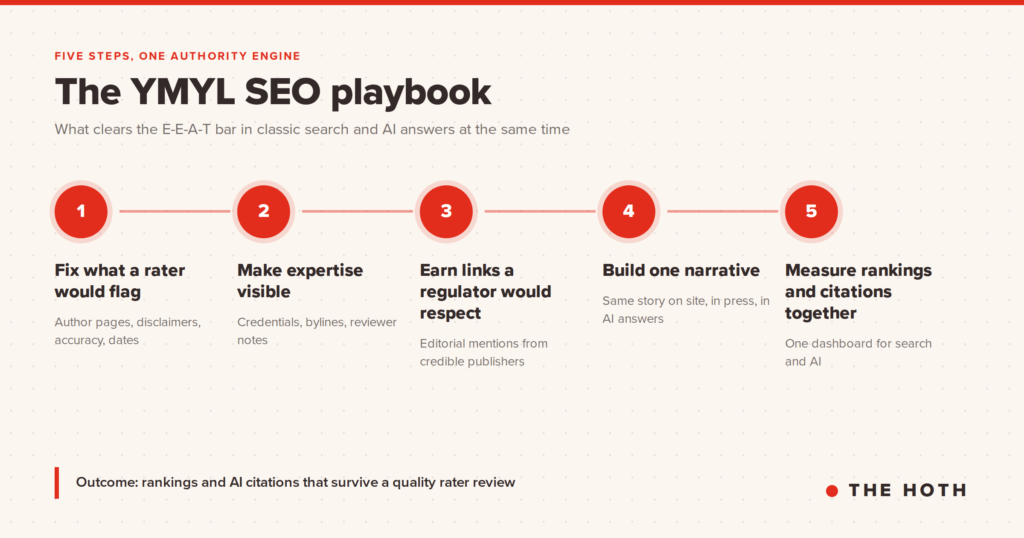
The YMYL playbook has five parts: get the technical and accuracy basics flawless, put real credentials on every page, earn editorial links and mentions from sources a regulator would respect, build one consistent authority narrative across those placements, and measure rankings and AI citations together. None of it is exotic. The difference in YMYL is that you cannot skip any of it.
1. Fix what a rater would flag first
Start with a technical audit and an accuracy audit in the same pass. Broken pages, thin service pages, outdated statistics, missing dates, and unclear disclosures all read as low quality to a rater and as risk to an AI system. Every YMYL page should make it obvious who is responsible for it, when it was last reviewed, and where the reader can verify the claims. Each of the medical and legal recoveries above started here.
2. Make expertise visible on the page
Bylines with credentials, a medical or legal reviewer where appropriate, real author pages, and an about page that names the people behind the practice are the minimum. Keep the organization’s name, address, and credentials consistent everywhere it appears so the entity resolves cleanly. Structured data helps you qualify for rich results, but Google’s generative AI guide is explicit that no special schema is required for AI features, so treat it as hygiene rather than a lever.
3. Earn links a regulator would respect
This is the step that separated every winning campaign above from the stalled ones. Prioritize placements on industry associations, safety and advocacy organizations, local and trade news, respected roundups, and high-authority publications through Earned Media and Digital PR. Spread links across the homepage, core service pages, and supporting content rather than hammering one URL. If a placement would embarrass you in front of a licensing board, it will not help you with Google or with an AI assistant either.
4. Build one narrative, not a pile of mentions
The motorcycle accident firm earned citations because every placement told the same story: this firm is the motorcycle injury authority in its state. AI systems assemble their picture of a brand from many sources, and a consistent narrative across those sources is what lets them connect the dots. Decide what you want to be known for, keep it narrow, and make sure your PR, your outreach anchors, and your service pages all agree.
5. Measure rankings and AI citations together
Track top-3 and top-10 keywords alongside AI citations by platform. Google’s Search Console generative AI performance report covers AI Overviews and AI Mode; third-party tools cover the rest. Expect the citations to lag the rankings. In our personal injury work, we have seen firms build strong service-page authority for a full year before citations register at scale, and that lag is normal in regional YMYL niches. If you are using a visibility score to make decisions, read our post on why your AI visibility number is wrong first.
How does HOTH X handle YMYL campaigns?
HOTH X is our managed SEO program: a dedicated campaign manager builds and runs the full stack for your site, including technical fixes, content, digital PR, and link building, which is the combination every YMYL result in this post came from. YMYL sites rarely succeed with a single product because the bar demands all of the signals at once.
Most of the clients in this post did not need a content vendor or a link vendor. They needed someone to look at their site the way a rater would, fix what would fail that review, and then build the authority that AI systems and Google’s ranking systems both require before they will trust a legal, medical, or financial source. That is the job HOTH X was built for.
If your practice, clinic, or firm is publishing good work and still losing ground to competitors who get cited, the missing piece is almost certainly authority. Book a call with our team and we will show you what a rater would flag on your site and what it would take to fix it.
Frequently asked questions about YMYL SEO
What does YMYL stand for?
YMYL stands for Your Money or Your Life. It is the term Google uses in its Search Quality Rater Guidelines for topics that could significantly impact a person’s health, financial stability, safety, or the welfare of society. Legal, medical, financial, insurance, and civic content are the most common examples.
Is YMYL a ranking factor?
Not directly. YMYL is a classification raters use when evaluating page quality, and their ratings are aggregated to test and train Google’s automated systems. In practice, that means the systems are taught to demand stronger E-E-A-T signals for YMYL topics, so the effect on rankings is real even though no single rating changes a page’s position.
Which industries count as YMYL?
Law firms, medical and dental practices, mental health providers, hospitals, lenders, banks, insurance agencies, financial advisors, tax services, and safety-related businesses are the clearest cases. Ecommerce sites selling health products or handling significant transactions can also land inside the category.
Do AI assistants treat YMYL sites differently?
Google says its AI features are rooted in the same ranking and quality systems as classic Search, so the higher YMYL bar carries over. Other assistants ground legal, medical, and financial answers in retrieved sources because the models alone are unreliable on verifiable facts in those domains. Either way, the sites that get cited are the ones with demonstrable authority.
How long does YMYL SEO take to work?
Rankings and traffic can move within 90 days when authority is the missing piece, as the law firm above showed. AI citations usually lag rankings, and in regional niches they can take a year or more to register at scale. Finance results in particular compound over 18 to 24 months.
Can AI-written content rank on a YMYL site?
Google’s guidance is that content produced with AI assistance is acceptable when it meets the same helpfulness and spam standards as anything else. On YMYL topics, that bar includes accuracy, credentialed review, and clear responsibility for the page, so AI drafting without expert oversight is a liability rather than a shortcut.
Leave a comment