
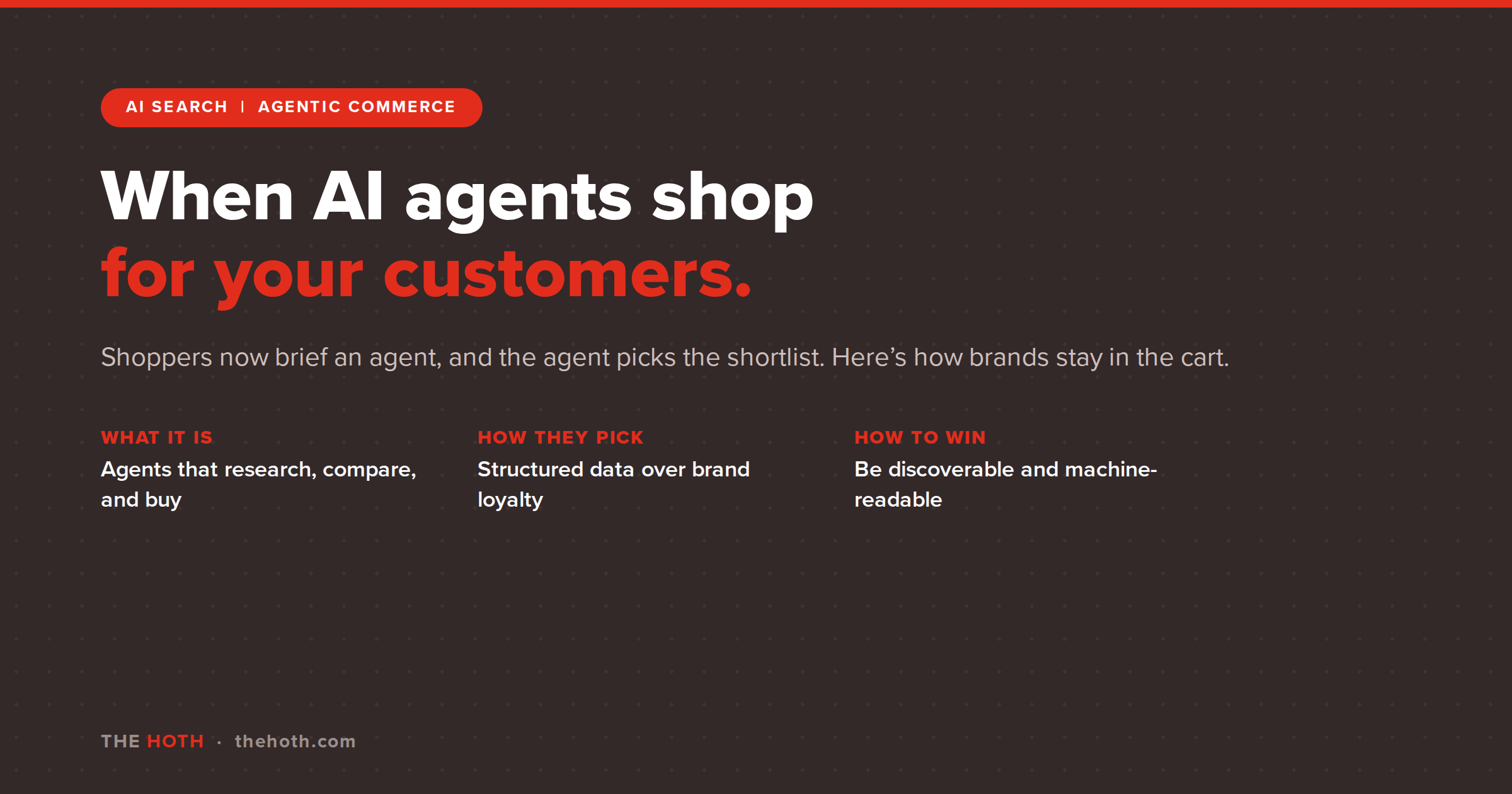

Agentic commerce is delegated shopping: AI agents research, compare, and complete purchases on a person’s behalf. Instead of browsing your site, the shopper briefs an agent, and the agent decides which products make the shortlist. To stay visible, your brand has to be both discoverable in AI answers and readable as structured product data an agent can parse.
Ask ChatGPT, Gemini, or Perplexity for a lightweight carry-on under $200 that fits major airline limits, and you won’t get ten blue links. You’ll get two or three specific products, already compared and ready to buy. The agent did the searching, the filtering, and increasingly the checkout. The shopper never visited a category page.
That’s agentic commerce, and it’s not a forecast. It’s live across the biggest AI platforms right now, with real money moving through it. This guide covers what agentic commerce is, how AI shopping agents really pick products, and the specific, technical steps that keep your brand in the consideration set instead of invisible at the moment of decision.
What is agentic commerce?
Agentic commerce is a model where AI agents act on behalf of shoppers to discover, evaluate, and buy products. The customer expresses intent in natural language, and the agent handles the research and often the transaction, compressing the entire shopping journey into a single conversation.
Deloitte frames it as a spectrum: from assisted discovery (recommendations), to assisted shopping (a conversational helper), to agentic shopping (the agent compares and buys through conversation), to fully autonomous shopping where an agent transacts within limits you preset. We’re now solidly in the agentic phase, with autonomous close behind.
The mechanics matter for marketers because they invert the funnel. In classic ecommerce, discovery happened on your site or a search results page. In agentic commerce, discovery happens inside the agent, before the shopper ever reaches you. As one PwC analysis puts it, you may no longer control the front door, but you still need to control the store behind it.
Agentic commerce is already here
AI shopping agents are live and transacting across ChatGPT, Google Gemini, Microsoft Copilot, Perplexity, and Amazon, backed by new commerce protocols from OpenAI, Google, Stripe, Visa, and Mastercard. This is a production channel, not an experiment.
The build-out happened fast. A few of the milestones that matter:
- OpenAI launched Instant Checkout in ChatGPT, letting US users buy without leaving the chat, powered by the Agentic Commerce Protocol co-developed with Stripe. Etsy went live first, with over a million Shopify merchants onboarding behind it.
- Google added native checkout across AI Mode and Gemini, and its Business Agent lets merchants power AI commerce from their existing Google Merchant Center feeds.
- Amazon’s Rufus assistant gained a “Buy for Me” feature that completes purchases on external sites for the shopper.
- Visa and Mastercard both rolled out agent-payment rails to handle transactions an AI initiates, with Visa partnering directly with OpenAI.
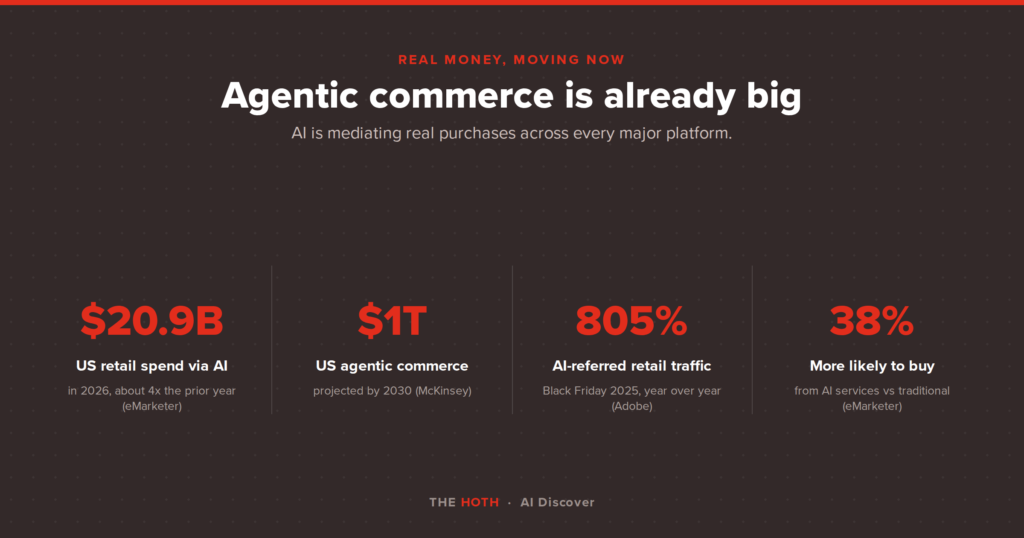
The money follows the infrastructure. eMarketer projects that AI platforms will account for roughly $20.9 billion in US retail spending in 2026, close to four times the prior year, and McKinsey estimates agentic commerce could orchestrate up to $1 trillion in US retail revenue by 2030. Adobe found AI-referred traffic to US retail sites grew 805% year over year on Black Friday 2025, and shoppers arriving from AI services are about 38% more likely to buy than those from traditional channels.
How AI shopping agents pick products
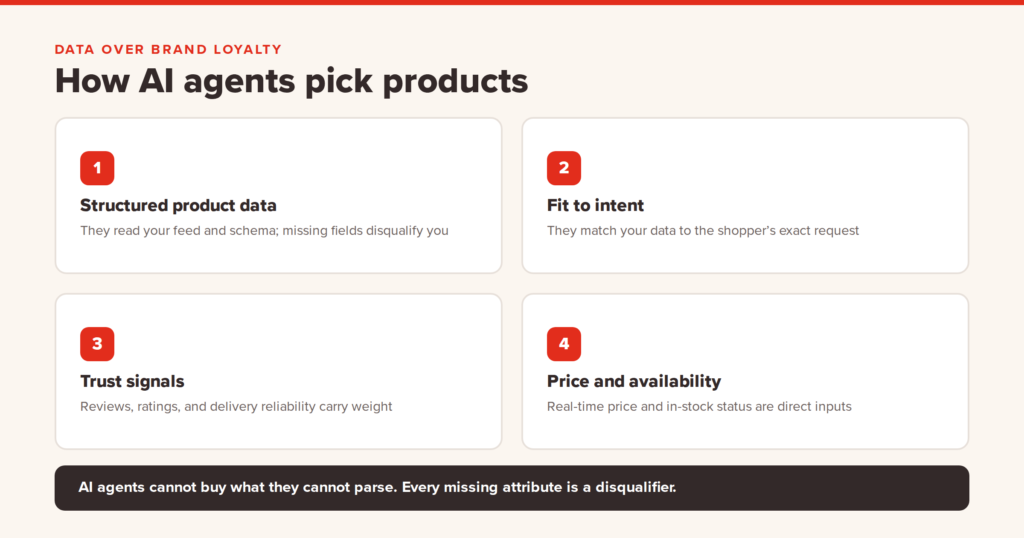
AI shopping agents pick products by reading structured product data and weighing price, user ratings, delivery speed, and real-time availability against the shopper’s stated intent. They prioritize the best-matching, machine-readable option over brand familiarity, so the brand with the cleanest, most complete data often wins.
This is the most important shift to understand, because the selection criteria are not the ones that won classic SEO. An agent reduces a wide field to a handful of options, and it does that on signals it can parse and trust:
- Structured product data. The agent reads your title, description, attributes, price, and availability from a feed or schema. Missing or wrong data is disqualifying, because an agent cannot infer what isn’t there.
- Fit to intent. It maps the shopper’s natural-language request, including constraints like size, use case, and budget, to the products whose data matches most precisely.
- Trust signals. Reviews, ratings, and delivery reliability carry heavy weight, the same trust signals AI search uses when deciding which sources to cite.
- Price and availability. Real-time pricing and in-stock status are direct inputs, not afterthoughts.
Two things follow from this. First, as Search Engine Journal has noted, missing or incorrect structured data makes your products effectively invisible to agent-mediated discovery. Second, agents value precise data over brand loyalty, which means a smaller brand with excellent product data can beat a household name that fed the agent a thin or messy catalog. Put simply, AI agents cannot buy what they cannot parse.
The two layers of agentic visibility
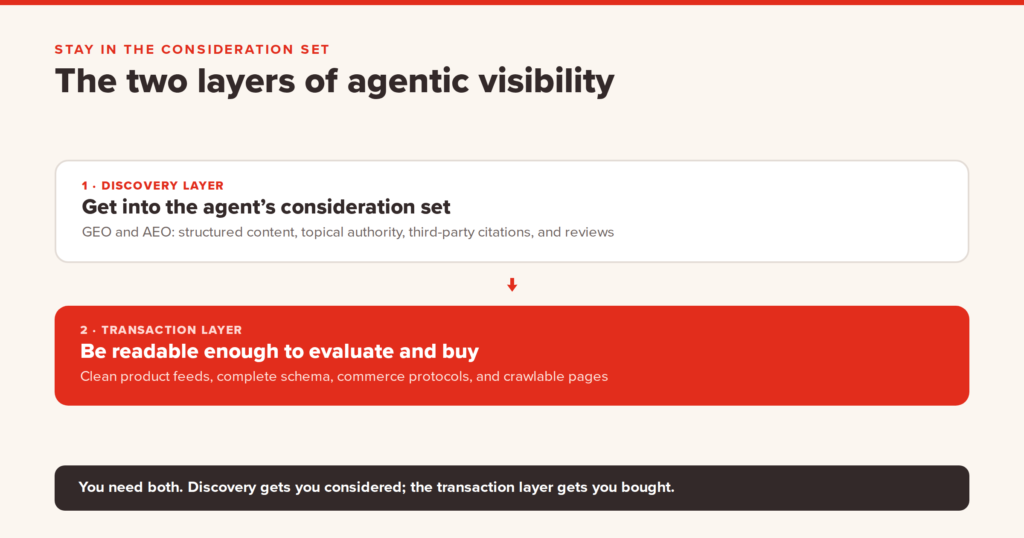
Staying visible to AI agents takes work on two layers: a discovery layer, where you earn a place in the agent’s consideration set through GEO and AEO, and a transaction layer, where clean product feeds, schema, and protocol readiness let the agent evaluate and buy.
Most brands focus on one layer and lose on the other. You need both.
The discovery layer is about being surfaced at all. Before an agent compares products, it assembles a consideration set from sources it trusts, and that’s governed by the same forces behind generative engine optimization and answer engine optimization: structured, authoritative content, third-party citations, and a strong review profile. If you’re not in the answer, you’re not in the cart.
The transaction layer is about being machine-readable once you’re surfaced. This is where product feeds, schema, and the new commerce protocols live. Get the discovery layer right and the agent considers you. Get the transaction layer right and the agent can evaluate and buy. The next two sections cover the technical work each one requires.
How to stay visible: the technical checklist
Here’s the concrete, machine-readable foundation an agent evaluates before your product enters a comparison set.
Mark up every product with schema
Start with schema.org/Product on every product page, and fill every attribute your platform supports: name, description, GTIN, brand, offers (with price and priceCurrency), availability, aggregateRating, review, and shippingDetails. Add Organization schema to confirm merchant identity, and FAQPage schema so agents can parse question-and-answer pairs as intent signals. Every empty field is a disqualifier, so completeness beats cleverness here.
Get your product feeds in order
Feeds are how agents ingest your catalog at scale. For Google’s surfaces, keep your Google Merchant Center feed complete, accurate, and refreshed frequently, since Google’s AI commerce pulls directly from it. For ChatGPT, the product feed accepts CSV, TSV, XML, or JSON and can be refreshed as often as every fifteen minutes, with fields including title (up to 150 characters), description (up to 5,000 characters), price with an ISO 4217 currency code, availability, images, and eligibility flags. Keep both feeds current; stale price or stock data gets you dropped from the comparison.
Adopt the commerce protocols
The transaction itself runs on emerging open standards. OpenAI’s Agentic Commerce Protocol, co-developed with Stripe, powers buying inside ChatGPT and lets you sell through agents while keeping control of what’s sold, how your brand shows up, and how orders are fulfilled. Google’s commerce protocol powers checkout across AI Mode, Gemini, and Shopping from the Merchant Center feed. The protocols coexist, and the same clean product data makes you eligible on both, so the foundational work compounds rather than fragmenting.
Confirm the agents can crawl you
None of the above matters if the bots are blocked. Check that your robots.txt allows the crawlers behind these systems, including OAI-SearchBot for ChatGPT and Googlebot for Google’s AI surfaces. If your robots.txt or firewall blocks them, your products are invisible to those agents no matter how good your data is. This is the single fastest audit to run, and the most common silent failure.
How to stay visible: the discovery work
Technical readiness gets you into the transaction. Discovery work gets you into the consideration set in the first place, and it looks a lot like strong AI search visibility. Lead every page with a clear, direct answer rather than brand voice, structure content into extractable question-and-answer units, and build genuine topical authority so agents recognize you as a credible source. Use-case content matters as much as specs: agents map intent like “good for wide feet” or “quiet enough for a nursery,” so spell out what your product is for, not just what it is. And because AI systems weigh third-party sources heavily, earned media and citations on trusted publications, plus a strong presence on review platforms, do real work in shaping which products an agent trusts enough to recommend.
A practical note from the field: don’t over-optimize for one platform too early. The smarter first move is to make sure you show up at all, with complete data and strong review signals, then refine per platform as you learn where your customers’ agents shop.
How to measure agentic commerce visibility
Measure agentic commerce on share of answer and citation, assisted and AI-referred traffic, and the completeness of your product data, not on head-term rankings. The goal is being chosen by the agent, which classic rank tracking doesn’t capture.
Track how often your products appear in AI answers for your priority prompts, your share of those answers versus competitors, the assisted and AI-referred traffic reaching your product pages, and the health of your structured data and feeds. These are the inputs that predict agent selection. Traditional rankings increasingly don’t, since one analysis found only a small fraction of URLs cited by AI tools overlap with Google’s top results.
Where The HOTH comes in
Getting picked by AI shopping agents is an AI visibility problem first and a feed problem second, and both take ongoing work. AI Discover is our managed AI visibility program, built to earn the discovery-layer signals agents rely on: structured, authoritative content, earned media and citations, review presence, and tracking through our Atlas dashboard so you can see where you’re surfaced and where competitors are winning the recommendations you should be earning.
On the content side, our managed content team builds the use-case and answer-first product content that makes your catalog legible to agents in the first place. If you want to see where you stand before agents decide for your customers, book a call and we’ll map your AI visibility and the gaps costing you citations.
Frequently asked questions
What is agentic commerce?
Agentic commerce is delegated shopping, where AI agents research, compare, and buy products on a consumer’s behalf. The shopper states what they want in natural language, and the agent handles discovery and often the checkout.
How do AI shopping agents pick products?
They read structured product data and weigh fit to the shopper’s intent, price, user ratings, delivery speed, and real-time availability. They favor the best-matching, machine-readable option over brand familiarity, so complete, accurate product data is decisive.
How do brands stay visible to AI shopping agents?
On two layers. First, earn a place in the agent’s consideration set through GEO and AEO: structured content, authority, citations, and reviews. Second, make your catalog machine-readable with complete schema, clean Merchant Center and ChatGPT feeds, protocol adoption, and crawlable product pages.
Is agentic commerce really being used?
Yes. It’s live across ChatGPT, Gemini, Copilot, Perplexity, and Amazon, and eMarketer projects roughly $20.9 billion in US retail spending through AI platforms in 2026. McKinsey estimates up to $1 trillion in US retail revenue could run through agentic commerce by 2030.
Does traditional SEO still matter for agentic commerce?
It helps but isn’t enough on its own. Strong SEO supports the authority agents trust, but agent selection runs on structured product data, schema, feeds, and reviews that classic rankings don’t capture, which is why GEO and feed readiness now sit alongside SEO.
What product data do AI agents need?
Complete, accurate, structured data: schema.org/Product fields like name, GTIN, brand, price, availability, and ratings, plus complete Merchant Center and ChatGPT feeds. Every missing attribute can drop you from the comparison set.
The bottom line
Agentic commerce moves the decision upstream, into a conversation with an agent that picks a short list before your customer ever reaches your site. Winning it isn’t about ranking first; it’s about being both discoverable in AI answers and readable as clean, structured product data the agent can trust. Build the discovery layer and the transaction layer together, measure on citations and assisted traffic rather than head-term rank, and you’ll stay in the cart as shopping moves from browsing to briefing.
Want to know whether AI agents can find and recommend your products today? Talk to our team and we’ll map your agentic visibility and where to fix it first.
Leave a comment