

Generative engine optimization (GEO) is the practice of optimizing your content so that AI tools like ChatGPT, Perplexity, Google’s AI Overviews, and Claude cite your brand when generating answers.
That’s the short version.
The longer version? AI search is rapidly replacing the way people find information online. And instead of competing for 10 blue links on a Google SERP, you’re now competing for 2 to 7 citation spots inside an AI-generated response.
That’s a much smaller window. If your content isn’t structured, sourced, and authoritative enough to earn one of those spots, you don’t show up at all.
How big of a deal is this, really?
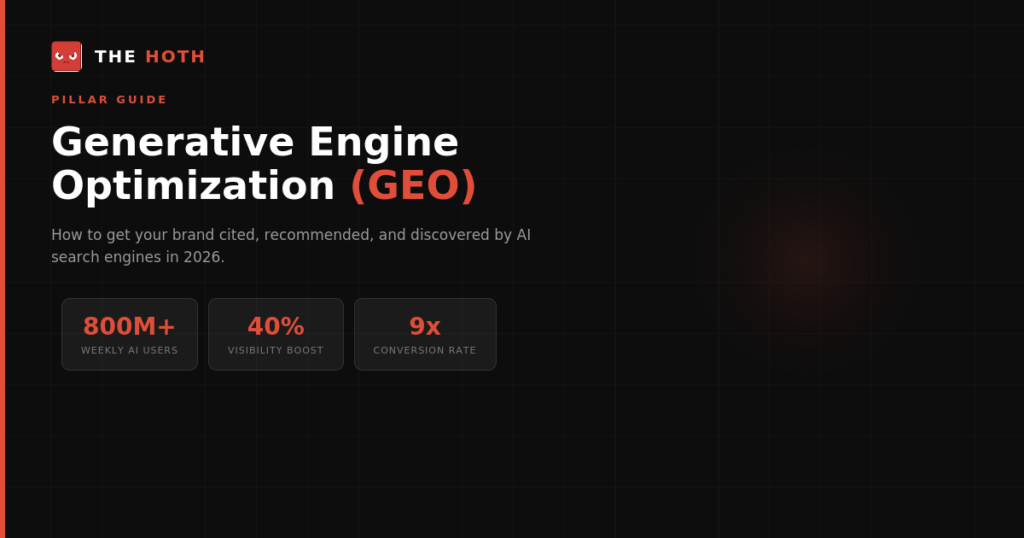
ChatGPT now has over 800 million weekly active users. That’s up from 400 million just a year ago. Google’s AI Overviews appear on 40%+ of all searches. And our own data at The HOTH shows that visitors who arrive through AI referrals convert at 9x the rate of standard organic traffic.
So yes. It’s a big deal.
And here’s the part that should really get your attention: this isn’t a winner-take-all scenario where only massive brands benefit. The Princeton study found that smaller, lower-ranked sites actually saw the biggest gains from GEO optimization. More on that in a moment.
This guide breaks down what GEO is, how it works, and how to start implementing it alongside your existing SEO strategy. We’ll also cover the academic research behind it, the tactics that move the needle, and how to track your results.
Let’s get into it.
What Is Generative Engine Optimization?
GEO is a framework for improving your brand’s visibility inside AI-generated responses.
The term was formalized by researchers at Princeton, Georgia Tech, the Allen Institute for AI, and IIT Delhi in a landmark study published in late 2023. It was later presented at ACM SIGKDD 2024, one of the most respected data science conferences in the world.
The researchers tested 10,000 queries across multiple generative engines and evaluated nine different optimization strategies.
The results were significant.
GEO tactics like adding statistics, citing sources, and including quotations improved content visibility by up to 40% in AI-generated responses.
Even more interesting? Pages that weren’t already dominating organic search saw the biggest gains. Pages ranked around position 5 experienced a 115% visibility increase after GEO optimization. Pages already at position 1 saw minimal change.
In other words, GEO is a massive opportunity for brands that aren’t yet dominating traditional search.
This is a key distinction. In traditional SEO, the rich get richer. Sites already at the top tend to stay there. In GEO, the playing field is more level. An AI doesn’t care that you’re on page 3 of Google if your content is more specific, better sourced, and more clearly structured than the page at position 1.
GEO isn’t about gaming an algorithm. It’s about making your content so credible, specific, and well-structured that an AI has no choice but to reference it when synthesizing an answer.
How Generative Engines Build Their Answers
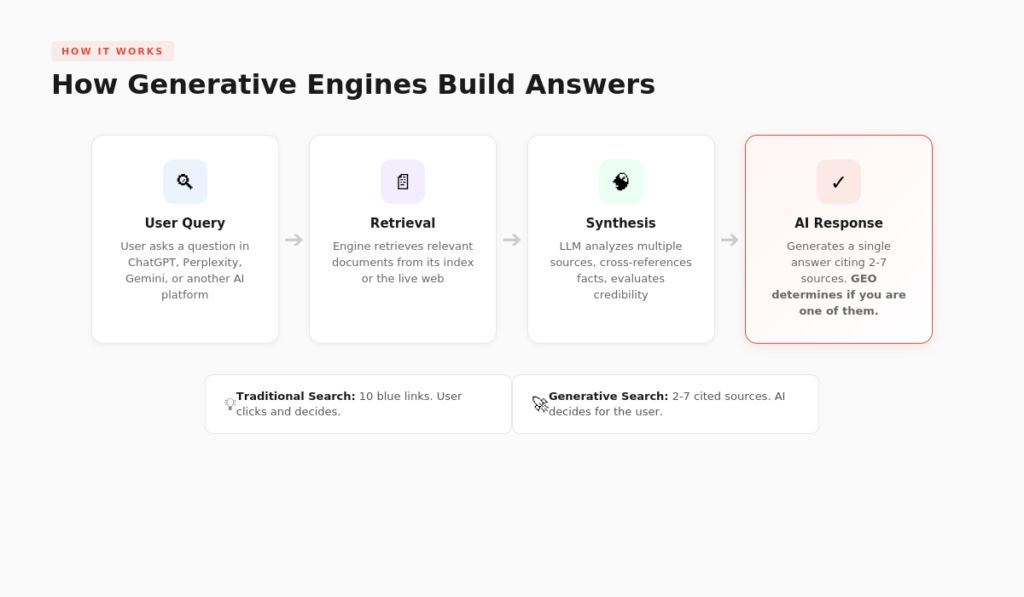
To optimize for generative engines, you need to understand how they work. And the process is fundamentally different from traditional search.
A traditional search engine crawls, indexes, and ranks pages. It shows you a list of links and lets you decide which one to click.
Generative engines don’t do this.
Instead, they follow a retrieve-then-synthesize workflow:
- Retrieval. The engine pulls relevant documents from its index or the live web.
- Analysis. The LLM reads across multiple sources, cross-references facts, and evaluates credibility.
- Synthesis. It generates a single unified answer and selects 2 to 7 sources to cite.
Here’s the critical difference.
In traditional search, you pick the winner by clicking a link. In generative search, the AI picks the winner by choosing which sources to cite.
Your content doesn’t just need to rank well. It needs to be the kind of content an AI would trust enough to cite.
And the AI isn’t matching keywords. It’s evaluating meaning, credibility, and completeness. If your page says the same thing as twenty others but says it worse, it’s getting skipped.
There’s another layer here worth understanding.
Traditional search engines evaluate pages individually. Generative engines evaluate them against each other. The AI is actively comparing your content to competing sources in real time, deciding which one explains the concept more clearly, provides better evidence, and carries more weight.
That’s why keyword stuffing is especially useless in GEO. The AI sees right through it.
As we explored in our deep dive on how answer engines decide what to cite, the selection process comes down to vector search (semantic similarity) vs. classic keyword matching. AI engines layer both approaches, which is why strong SEO fundamentals still matter.
GEO vs. SEO vs. AEO: How They’re Different
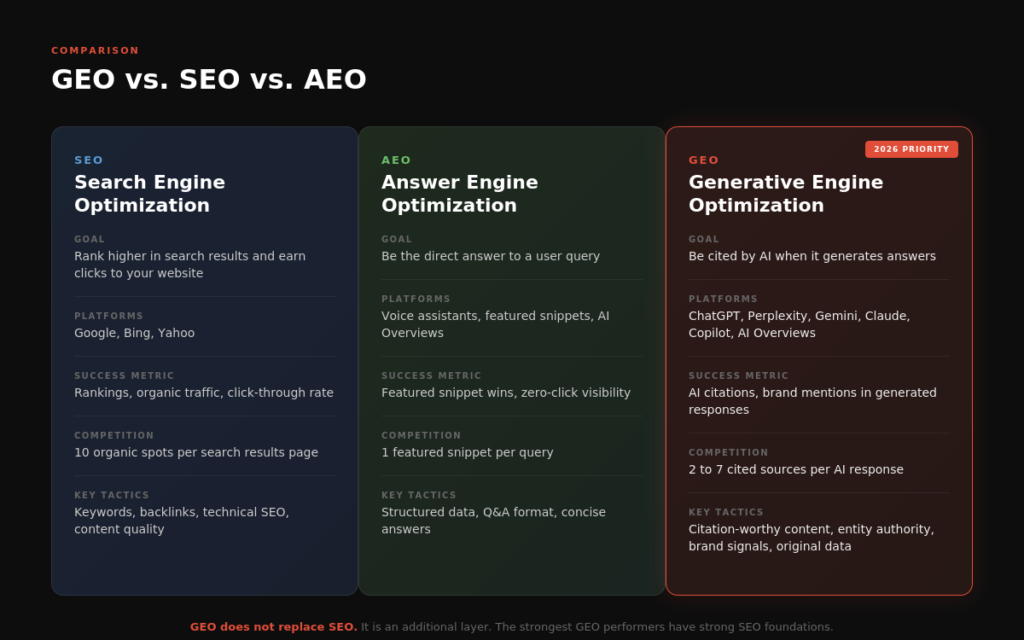
These three acronyms get tossed around a lot. There’s real overlap between them, but they aren’t interchangeable.
| SEO | AEO | GEO | |
| Goal | Rank higher in search results | Be the direct answer to a query | Get cited when AI generates answers |
| Platforms | Google, Bing, Yahoo | Snippets, voice assistants, AI Overviews | ChatGPT, Perplexity, Gemini, Claude, Copilot |
| Metric | Rankings, traffic, CTR | Snippet wins, zero-click visibility | AI citations, brand mentions in AI responses |
| Competition | 10 organic spots per SERP | 1 featured snippet per query | 2 to 7 cited sources per response |
| Tactics | Keywords, backlinks, technical SEO | Structured data, Q&A format, concise answers | Original data, entity authority, citation-worthy content |
The most important takeaway: GEO does not replace SEO.
As we explained in our breakdown of the structural shift from SEO to AEO, AI search is layered on top of classic search, not replacing it.
A study by Originality.ai found that 48% of AI citations come from the top 100 organic results. Nearly half of AI sources are already ranking well in traditional search.
But the flip side matters just as much: 52% of citations come from outside the top 100. Organic rankings alone are not enough.
Think of it this way: SEO gets you indexed. AEO gets you into featured snippets. GEO gets you cited by the AI that’s replacing those snippets.
Why GEO Matters Right Now
Is this really urgent, or just another buzzword?
The data says it’s urgent.
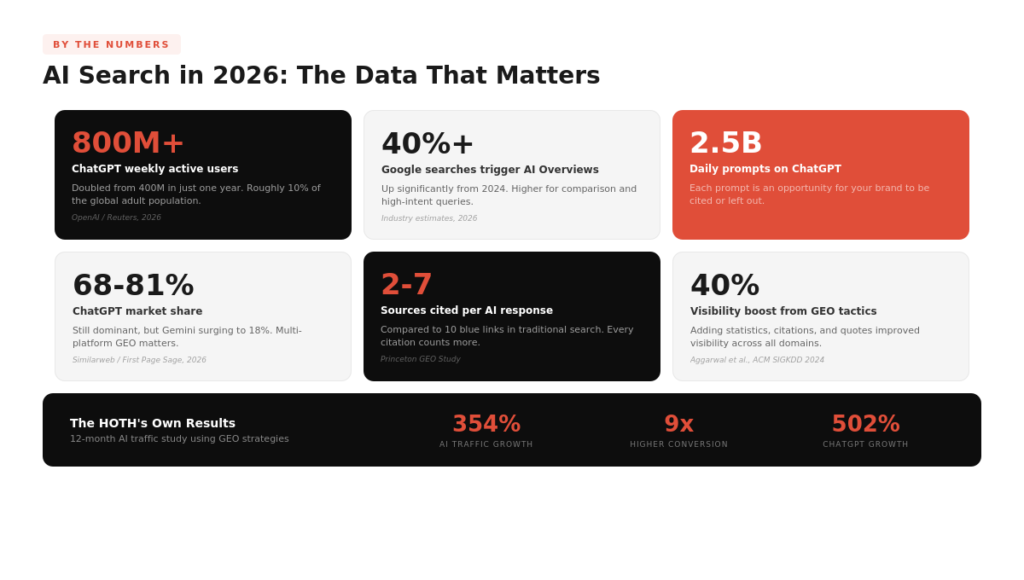
- 800 million+ weekly active users on ChatGPT, processing 2.5 billion daily prompts. That’s roughly 10% of the global adult population using one AI tool every single week.
- AI Overviews now appear on 40%+ of Google searches. And updated research from Ahrefs shows they reduce organic CTRs by up to 58%.
- ChatGPT holds 68-81% of the AI search market, but Gemini is surging at 237% year-over-year growth. Perplexity, Claude, and Copilot are all gaining ground.
- AI-referred visitors convert at dramatically higher rates. Our data shows 9x conversion vs. standard organic, at $259 average revenue per AI-referred user.
Consider the math. A traditional SERP gives you 10 organic slots. An AI response cites 2 to 7 sources. That’s a 30% to 70% reduction in available visibility.
But the visitors who do arrive through AI citations are far more valuable. When an AI recommends your brand by name, it carries implicit endorsement. Those users are further down the funnel before they ever hit your site.
There’s also a real first-mover advantage here. Most businesses are still exclusively focused on traditional SEO. Brands that layer GEO onto their strategy now will build compound authority before competitors catch up.
And unlike paid search, where visibility disappears the second you stop spending, GEO results compound. Every brand mention, every citation, every piece of original data builds on the last. The earlier you start, the harder it becomes for competitors to catch up.
What AI Engines Look for When Choosing Sources
What makes a generative engine choose your page over someone else’s?
It’s not one thing. It’s a combination of signals that tell the AI your content is worth trusting.
As we covered in our deep dive on citation logic, most top-ranked organic pages fail to earn AI citations because they’re built for human readability but not machine extractability.
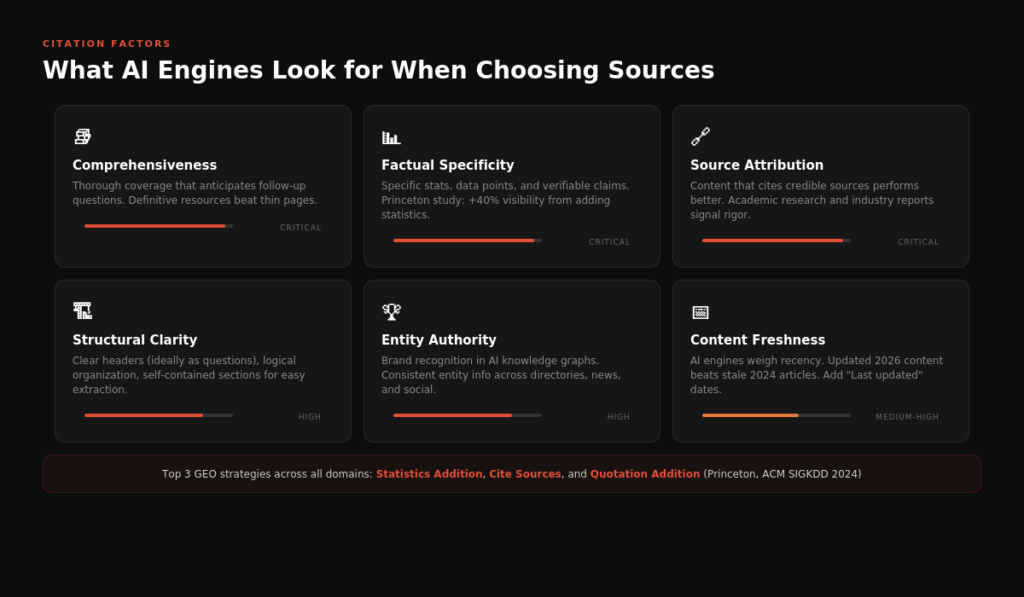
Here are the six factors that matter most.
Comprehensiveness
Generative engines prefer content that anticipates follow-up questions. Thin pages get skipped. Definitive resources that cover a topic from multiple angles get cited.
Factual specificity
The Princeton study found that adding statistics was the single most effective GEO strategy, improving visibility by up to 40%. Specific numbers beat vague generalizations every time.
Source attribution
Content that cites credible sources performs better. References to academic research, government data, and industry reports all signal rigor. The Princeton researchers listed cite sources and quotation addition among the top three GEO tactics.
Structural clarity
Clear headers (ideally phrased as questions), logical organization, and self-contained sections make extraction easier.
Walls of text with no clear structure are a problem. If the AI can’t quickly find the specific answer it needs, it moves on to a source that makes it easier.
This overlaps with what we covered in our guide on structured data for AI search. Structured data builds clarity, not authority. But clarity directly supports citation eligibility.
Entity authority
This is where brand signals come in.
AI engines evaluate your brand’s presence across the web: directories, news mentions, social profiles, reviews, and entity consistency. A strong entity profile tells the AI you’re a real, trusted business. A weak one tells it you’re a question mark.
According to Ahrefs, brand mentions, branded anchors, and branded search volume were the three most important visibility factors for LLMs. We covered this in detail in our guide on the three tiers of brand mentions.
Here’s what trips up a lot of brands: they have great on-page content, but nobody else on the internet is talking about them. And AI notices that gap.
If your brand doesn’t exist as a recognizable entity across multiple trusted sources, on-page optimization alone won’t save you.
Content freshness
AI engines weigh recency. An updated 2026 article with a visible “Last updated” date beats a stale 2023 article on the same topic.
This is one reason a consistent content refresh cadence is so important for GEO.
7 GEO Strategies That Work in 2026
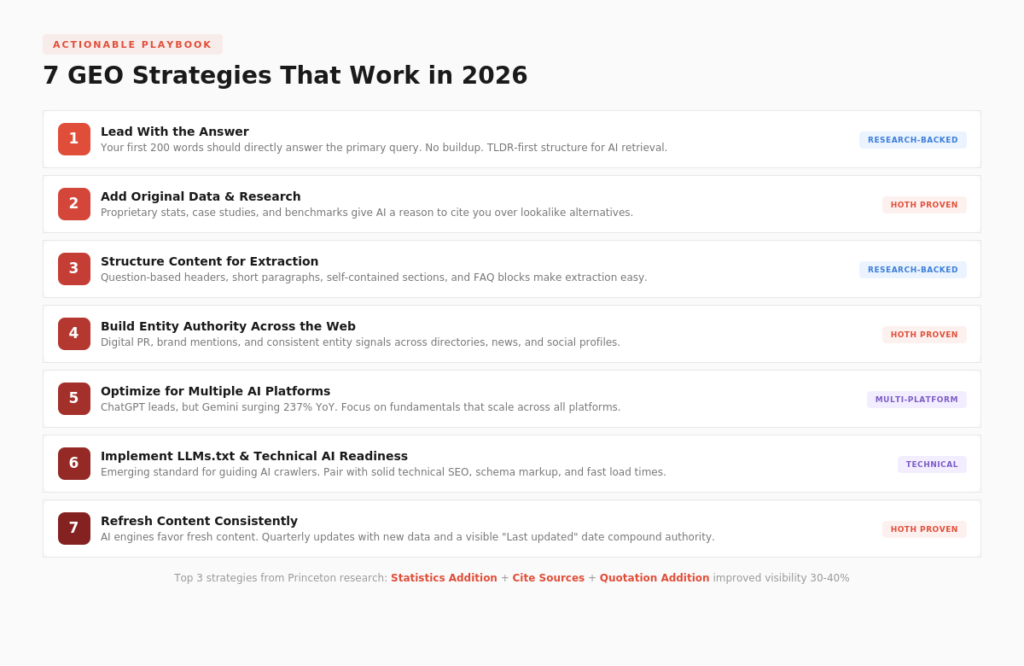
Based on the Princeton research, our own testing at The HOTH, and what we’re seeing across client campaigns, these are the seven strategies that consistently improve AI visibility.
1. Lead with the answer
Your first 100 to 200 words should directly answer the primary query. No lengthy intro. No backstory. Answer first, elaborate after.
This is the TLDR-first structure. It works because generative engines look for extractable content. If your answer is buried in paragraph eight, the AI may never get to it.
Write your first paragraph as if it’s the only thing the AI will read. Because sometimes it is.
2. Add original data and research
Proprietary stats, case studies, and benchmarks give AI a reason to cite you instead of a dozen lookalike articles.
Think about it from the AI’s perspective. It’s reading 30 pages about the same topic. Most of them say roughly the same thing. But one of them includes a specific data point nobody else has. That’s the one getting cited.
Original data is the single biggest differentiator in a world where AI can summarize commodity content in seconds.
Our own AI traffic case study showing 354% AI traffic growth is the kind of original data that earns citations. Nobody else can replicate it.
You don’t need a massive research team to pull this off. Even simple things like client results, internal benchmarks, survey data, or before-and-after comparisons give you an edge over generic content.
3. Structure content for extraction
Use question-based headers. Keep paragraphs short. Make each section self-contained so an AI can extract it without needing context from the rest of the page.
Think of your content as a collection of standalone answer blocks. Each section should make sense on its own, even if pulled out of the article entirely. That’s how AI engines actually use your content. They grab snippets, not full pages.
FAQ sections are especially effective here. AI engines love clearly labeled Q&A blocks because they map directly to user queries.
Pair these with proper schema markup and you give generative engines exactly what they want: clean, labeled, machine-readable answers.
4. Build entity authority across the web
You can’t GEO your way to AI visibility with on-page tactics alone. Your brand needs to exist as a recognized entity across the web.
That means:
- Digital PR to earn brand mentions on authoritative publications
- Consistent NAP information across directories, social profiles, and review platforms
- Branded anchors in high-quality editorial content
- Active review profiles on Google, Yelp, and industry-specific platforms
This is where digital PR becomes a core GEO tactic, not just an SEO one. If trusted publications are consistently mentioning your brand, AI tools will take notice.
We explored this connection in depth in our guide on digital PR’s role in AI visibility.
5. Optimize for multiple AI platforms
ChatGPT gets most of the headlines, but Gemini grew 237% year over year. Perplexity, Claude, and Copilot are all growing too.
Each platform has slightly different retrieval methods, but the fundamentals are the same: authoritative, well-structured, citation-worthy content works everywhere.
Don’t over-index on one platform. We covered the nuances in our guide on SEO for Perplexity, Claude, and ChatGPT.
6. Get your technical house in order
Make sure AI crawlers can actually access your content. Plenty of sites accidentally block AI bots in their robots.txt without realizing it.
Check your robots.txt file right now. If you see lines blocking GPTBot, ClaudeBot, or PerplexityBot, you’re actively preventing those platforms from citing your content.
Beyond crawlability, technical AI readiness includes:
- Schema markup (FAQPage, HowTo, Article, Organization)
- LLMs.txt, an emerging standard that acts like robots.txt for AI crawlers
- Fast load times and clean site architecture
- Structured data that reduces parsing errors and inference guesswork
7. Refresh content consistently
AI engines favor fresh content. A quarterly content refresh cadence, with updated stats, new sections, and a visible “Last updated” date, compounds authority over time.
A page published in 2023 and never touched again will steadily lose AI visibility to competitors who keep their content current.
This isn’t just theory. We saw it firsthand: pages that received quarterly refreshes earned 502% more ChatGPT referral traffic over 12 months compared to static pages.
Content freshness also feeds back into your other GEO efforts. Each refresh is an opportunity to add new data points, update source citations, and improve structure. It’s not just about changing a date. It’s about making the content genuinely better each time you touch it.
How to Measure GEO Performance
GEO measurement is still evolving. But there are several ways to track progress right now.
AI citation frequency
Tools like Ahrefs Brand Radar and BrightEdge AI Catalyst track how often your brand appears in AI-generated responses. We covered the full toolkit in our guide on tracking your brand in AI.
AI referral traffic
Check your analytics for traffic from ai.chatgpt.com, perplexity.ai, and similar sources. This is the most direct signal that AI tools are citing your content.
Most analytics platforms now recognize these referral sources. If yours doesn’t, set up a custom channel group that captures AI-specific referring domains. You want to be able to see this data at a glance, not buried in a raw referral report.
Brand mention volume
Track mentions using BuzzSumo, Ahrefs Alerts, or Semrush Brand Monitoring. More mentions typically correlate with more AI citations, since brand mentions are a top LLM visibility factor.
Prompt-specific tracking
Create a list of 20 to 50 prompts that matter to your business. Check them monthly across ChatGPT, Gemini, and Perplexity. Note who gets cited.
This also reveals who your AI competitors actually are. They’re not always the same brands you’re competing with in organic search.
What good GEO metrics look like
For context, here are benchmarks from our own GEO campaigns:
- AI referral traffic: 354% growth over 12 months
- ChatGPT referrals: 502% growth in the same period
- AI conversion rate: 18.4%, compared to 2.1% from standard organic
- Revenue per AI visitor: $259 average
Similar patterns are emerging across e-commerce, SaaS, legal, and home services verticals. The common thread is that brands investing in entity authority and citation-worthy content are seeing outsized returns.
GEO and SEO Work Best Together
GEO does not replace SEO. They’re complementary.
Here’s why they overlap so well:
- Backlinks still signal trust. Sites with contextually relevant backlinks on trusted domains carry authority on answer engines too. But as we covered in our citation logic guide, this only applies to links with real editorial quality. Inflated profiles don’t translate.
- Content quality standards overlap. Google’s E-E-A-T framework applies to AI search too. Experience, expertise, authority, and trustworthiness get rewarded in both systems.
- Technical SEO is the foundation. Clean architecture, fast load times, and proper structured data help search engines and generative engines understand your content.
The best approach is to treat GEO as an additional layer on top of your SEO, not a separate campaign. Every blog post, product page, and resource you create should be built for both traditional and AI search.
The good news? Most of the work overlaps. If you’re already creating in-depth, well-sourced content with strong E-E-A-T signals, you’re most of the way there. GEO just adds a few more steps: tighter structure, more original data, and an intentional focus on entity authority.
That’s the approach behind AI Discover, our managed visibility program. It combines link building, digital PR, content refresh, and AI-specific optimization into one integrated strategy.
The results: 354% AI traffic growth and 9x conversion rates from AI-referred visitors over 12 months.
Common GEO Mistakes to Avoid
GEO is new enough that bad advice is everywhere. Here are the mistakes we see most often.
Treating GEO as an SEO replacement
Nearly half of AI citations come from pages in the top 100 organic results. SEO is the foundation. GEO is the layer on top.
Over-indexing on ChatGPT
ChatGPT is dominant today. But the market is shifting fast. Gemini is surging. Perplexity is carving out a niche with researchers and professionals. Claude is gaining traction for long-form reasoning.
Optimize for fundamentals that work across all platforms, not tricks that work on one.
Adding schema and expecting instant citations
Structured data helps AI parse your content. It doesn’t build authority. Schema is the packaging, not the product.
Ignoring off-site signals
Too many GEO guides focus entirely on on-page tactics. But entity authority, built through brand mentions, digital PR, and reviews, is arguably the most important GEO factor.
If the AI doesn’t recognize your brand as a credible entity, no amount of on-page work will get you cited.
Publishing and forgetting
A page published once and never updated will steadily lose AI visibility. Build a content refresh cadence into your calendar. Treat it as non-negotiable.
Getting Started: A Quick-Start Checklist
Ready to get going? Here’s where to start:
- Audit your AI visibility. Test 10 to 20 relevant prompts on ChatGPT, Gemini, and Perplexity. See if your brand gets cited. Note who does.
- Optimize your top pages. Pick your 5 highest-traffic pages. Add statistics, cite sources, restructure for extraction, update dates.
- Add schema markup. Implement FAQPage, HowTo, Organization, and Article schemas. Our guide on schema markup for AI has the full breakdown.
- Invest in entity authority. Launch or scale digital PR to earn brand mentions on authoritative sites.
- Set a refresh cadence. Update key pages quarterly with fresh data and new sections.
- Set up tracking. Monitor AI referral traffic, activate Ahrefs Brand Radar, and create a prompt tracking spreadsheet.
Frequently Asked Questions About GEO
What does GEO stand for?
GEO stands for generative engine optimization. It’s the practice of optimizing content to earn citations in AI-generated responses from platforms like ChatGPT, Perplexity, Google AI Overviews, and Claude.
Is GEO the same thing as AEO?
Closely related, but not identical. AEO is the broader discipline of optimizing for any system that provides direct answers, including voice assistants and featured snippets.
GEO specifically focuses on generative AI systems that synthesize responses from multiple sources. It’s a newer and more specific challenge.
Does GEO replace SEO?
No. GEO builds on top of SEO. The Princeton research confirmed that pages with strong organic foundations benefit more from GEO tactics. You need both.
Think of SEO as the engine and GEO as the turbocharger. The turbocharger doesn’t work without the engine.
How do I know if AI is citing my content?
Use Ahrefs Brand Radar to monitor AI mentions at scale. Manually test relevant prompts on ChatGPT, Perplexity, and Gemini. Check your analytics for referral traffic from AI platforms (look for ai.chatgpt.com, perplexity.ai, etc.).
Full walkthrough in our guide on tracking your brand in AI.
What types of content perform best for GEO?
Comprehensive guides, data-driven research, FAQ sections, and content with clear source attribution. The Princeton study found that statistics, source citations, and direct quotations were the three most effective additions.
How long does GEO take to show results?
It depends on your starting point. Brands with strong SEO foundations (quality backlinks, topical authority, active reviews) may see improvements within weeks.
Brands building from scratch should expect 3 to 6 months to build enough entity authority for consistent AI visibility.
What is the Princeton GEO study?
A research paper by Princeton, Georgia Tech, Allen AI, and IIT Delhi that tested 10,000 queries across generative engines. It introduced the GEO framework and GEO-bench benchmark. Published at ACM SIGKDD 2024.
You can read the full paper on arXiv.
What tools do I need for GEO?
Ahrefs Brand Radar for AI mention tracking. BrightEdge AI Catalyst for structured visibility data. Google Search Console for traditional performance. Plus manual prompt testing across ChatGPT, Perplexity, Gemini, and Claude.
The Bottom Line
The way people find information is changing. Fast.
AI isn’t replacing search engines overnight. But it is reshaping how decisions get made.
When 800 million people per week are asking ChatGPT for recommendations, the brands that get cited win the trust, the traffic, and the conversions. The brands that don’t get cited become invisible.
GEO is how you stay visible.
The tactics aren’t complicated: lead with answers, add original data, structure for extraction, build entity authority, keep your content fresh.
The Princeton research proves these strategies work across 10,000 queries. Our own data proves they work at scale, with real revenue attached.
And the beauty of GEO is that it doesn’t require you to tear down your existing strategy. It builds on your SEO. Every dollar you’ve already invested in content, links, and authority makes GEO more effective.
Need help implementing GEO alongside your SEO strategy? AI Discover combines link building, digital PR, content optimization, and AI-specific tactics into a single managed program.
The brands that move now will own this space. The ones that wait will wonder where their traffic went.
Get started with AI Discover or book a free strategy call to talk through your GEO roadmap.
Leave a comment