

Financial services SEO is the work of building the authority and trust signals that help banks, lenders, advisors, and fintech brands rank in Google and get cited in AI answers. Because finance is a Your Money or Your Life topic, search engines and AI models hold it to a higher standard of expertise and trust than almost any other industry.
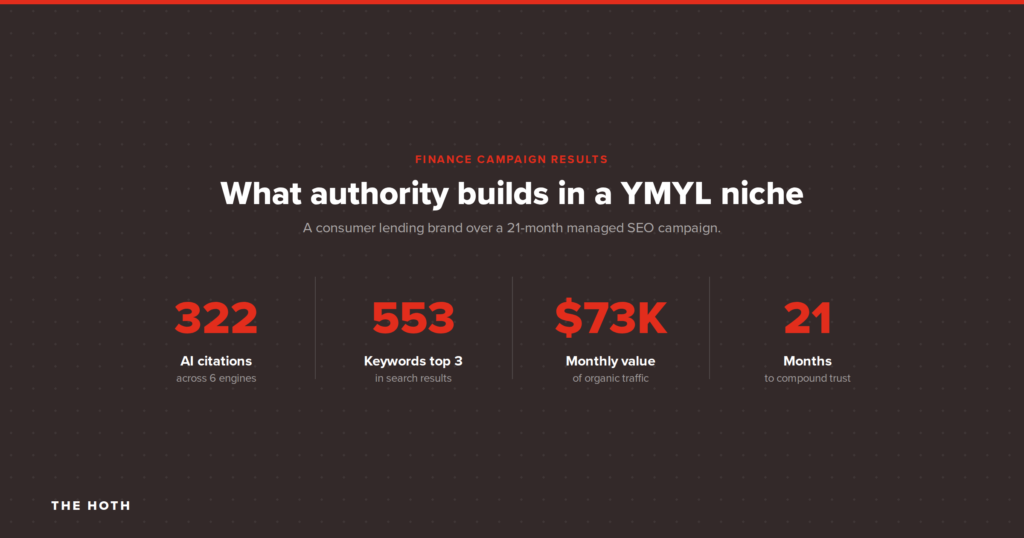
A consumer lending brand came to us with a familiar problem: strong products, a solid reputation, and almost no visibility in search. Twenty-one months into a managed SEO campaign, the picture looked different. The brand held 553 keywords in the top three positions, earned an estimated 73,000 dollars in monthly organic traffic value, and, most telling for 2026, was cited 322 times across six different AI engines.
That last number is the one that matters most right now. In financial services, the brands winning search are the same ones getting named when a customer asks ChatGPT which lender, advisor, or bank to trust. This guide explains why finance is one of the hardest niches to rank in, what moves the needle, and how to build the authority that both Google and AI systems reward.
Which financial services brands need SEO?
Financial services SEO applies to any brand that competes for trust online: banks and credit unions, lenders and mortgage brokers, financial advisors and wealth managers, insurance providers, fintech startups, and accounting or tax firms.
The specifics shift by sub-vertical. A local financial advisor competes on local search and referrals, so reviews and location signals matter most. A national lender competes on high-volume informational terms, where content depth and citations win. A fintech launching a new category has to build brand recognition from scratch, which leans on digital PR and earned media. What they share is the YMYL bar: every one of them is judged on trust before anything else.
Why is SEO for financial services so hard?
Finance is a Your Money or Your Life category, so Google and AI models apply their strictest standards for expertise, authority, and trust. A single thin or inaccurate page can sink a finance site that would rank fine in a lower-stakes industry.
Your Money or Your Life, or YMYL, is Google’s term for content that can affect a person’s finances, health, or safety. A page about the best banjo strings does not carry much risk if it is wrong. A page about refinancing a mortgage or choosing a retirement account does. Google knows this, so it holds finance content to the highest bar it has for expertise and trustworthiness.
That raises the stakes on everything. A single inaccurate figure, an outdated rate, or a page that reads like it was written by someone outside the industry can cost you rankings that would be safe in a less sensitive niche. Add decades-old incumbents with deep authority, aggregators that dominate comparison queries, and compliance rules that slow content down, and you have one of the most demanding SEO environments there is.
Compliance adds a layer most niches never deal with. Claims have to be accurate and often disclosed, rates and terms change, and legal review can slow publishing to a crawl. That makes consistency the hard part. The brands that win are the ones that keep producing accurate, expert content on a schedule despite the friction, rather than in occasional bursts that never build momentum.
What makes financial services SEO different from other industries?
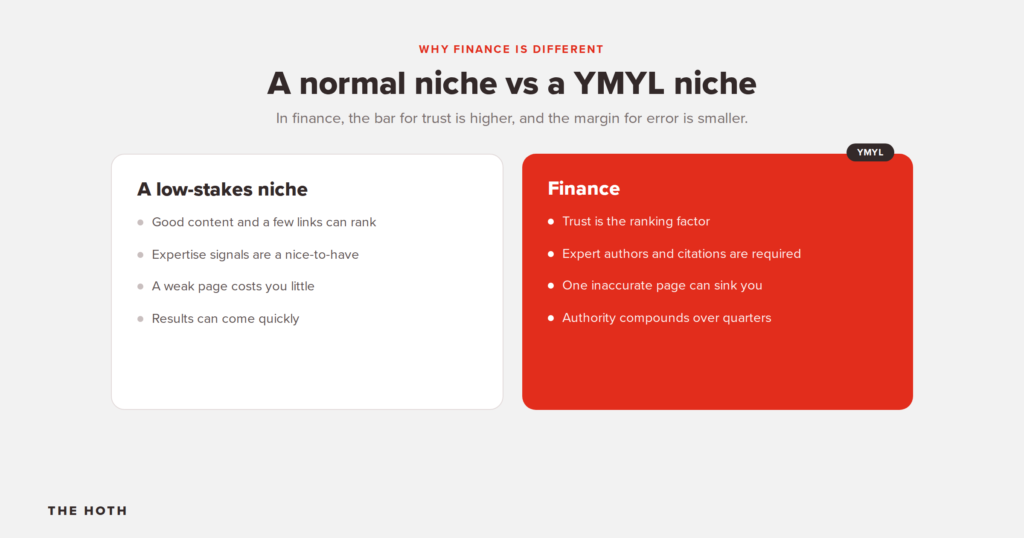
The difference is trust. In finance, search engines and AI systems weigh who is behind the content and what independent sources say about you far more heavily than they do in most niches.
In a lower-stakes industry, strong content and a few good links can carry you a long way. In finance, that is table stakes. What separates the brands that rank from the ones that stall is proof of trustworthiness: named authors with real credentials, accurate and current information, citations from publications that Google and AI models already trust, a clean reputation, and transparency about who you are and how you operate.
This is the experience, expertise, authoritativeness, and trust framework that Google’s quality raters use, and it applies to finance more strictly than almost anywhere else. You cannot keyword your way to the top of a finance results page. You earn your way there by looking, to both search engines and customers, like a brand worth trusting with money.
A concrete example makes the gap clear. Two pages can cover the same topic with the same keywords, but the one bylined by a certified financial planner, citing official data, on a site with strong reviews and news coverage, will outrank the anonymous one nearly every time. In most industries that edge is marginal. In finance it is decisive.
How do you build authority in a YMYL niche like finance?
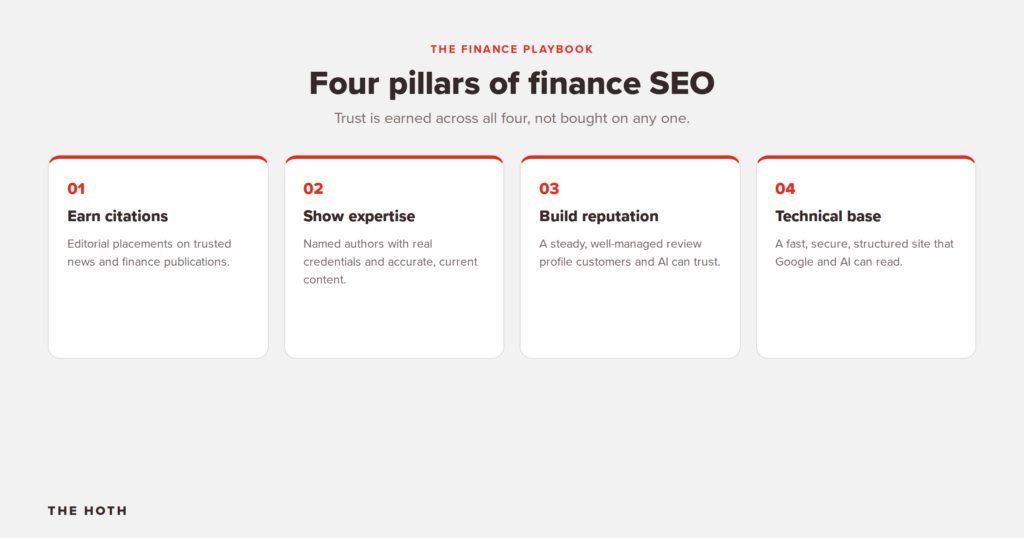
You earn citations on trusted publications, show real expertise on every page, maintain a strong reputation, and give search engines a clean, structured site to read. Those four pillars build the trust that finance SEO runs on.
Here is the playbook that works in finance specifically, in the order it tends to pay off.
Earn citations on trusted news and finance publications
Nothing builds authority in finance faster than being referenced by sources Google and AI models already trust. Editorial placements on real US news and finance sites tell both that your brand is credible. Our Exclusive News Links place your brand inside evergreen articles on DR 60 and higher news domains, and our Earned Media service earns journalist-written coverage across thousands of publishers. In a niche where trust is the ranking factor, these citations do the heavy lifting that a blog post on your own site cannot.
For finance specifically, prioritize placements on business and finance publications over general-interest blogs. Topical relevance amplifies the trust signal, so a mention in a finance outlet carries more weight for a lender than the same mention on a lifestyle site.
Show real expertise on every page
Finance content needs a visible author with genuine credentials, accurate figures, and current information. Google’s raters are explicitly told to check who produced YMYL content and whether the site is trustworthy. Add author bios that establish expertise, cite primary sources like regulators and official data, keep rates and rules current, and review pages regularly so nothing goes stale. A finance page that reads like it was written by a specialist earns trust that a generic one never will. Where you can, have content reviewed or bylined by a licensed professional, a certified financial planner, CPA, or similar, and say so on the page. That single signal separates credible finance content from the rest.
Build and manage your reputation
Reviews and brand sentiment carry extra weight in finance because customers are handing over money. A steady, well-managed review profile across Google and industry platforms signals trust to search engines and to the AI models that now read those reviews before they recommend a brand. Negative sentiment or a thin review presence is a bigger liability here than in almost any other vertical, so reputation work is not optional. Respond to reviews, resolve complaints publicly, and keep your profiles complete and consistent across platforms, because in finance an unanswered negative review does more damage than in most industries.
Get the technical and structural foundation right
Authority does not help if search engines cannot read your site. Clean site architecture, fast pages, secure hosting, and structured data give crawlers and AI models a clear picture of what you do and who you serve. Well-organized, clearly-labeled pages are also the ones AI engines find easiest to lift and cite, so the technical work pays off twice, once in Google and once in AI answers. Security signals matter more here too: visible trust markers, HTTPS, and clear privacy and compliance information reassure both users and the systems evaluating your site.
What keywords should financial services brands target?
Finance brands win by targeting three keyword types: informational YMYL questions, commercial service and product terms, and local terms for branches or advisors. The right mix depends on your model, and in 2026 you add conversational AI prompts on top.
Informational keywords are the questions your customers ask before they buy, like how a home equity loan works or what to look for in a financial advisor. These build topical authority and feed AI answers. Commercial keywords are the service and product terms closer to a decision, where your service pages compete. Local keywords matter for advisors, branches, and any brand serving a specific area, where the map pack and reviews decide who shows up.
In 2026, add a fourth layer: the conversational prompts people bring to AI. Someone no longer types best mortgage lender and scans ten links. They ask an assistant which lender fits their situation, then act on the answer. Structuring your content to answer those questions directly, in plain language a model can lift, is how you show up in the AI response and not just the blue links.
How does financial services SEO connect to AI visibility?
Directly. The authority and trust signals that rank a finance brand in Google are the same ones that get it cited in ChatGPT, Google AI Overviews, and Perplexity. Winning one increasingly means winning both.
Finance questions are exactly the kind people now bring to AI. Which lender should I use, is this bank trustworthy, what is the best account for my situation: these are high-stakes prompts, and AI models answer them by leaning hard on sources they consider authoritative. A brand that has earned trust across the web is the one that gets named. A brand that has not is invisible in the answer.
This is why the consumer lending brand we opened with earned 322 AI citations across six engines from the same authority work that drove its rankings. The trust signals did double duty. If you want to go AI-first with this, AI Discover is a managed program built around it, and our data on how news placements earn AI citations shows how quickly trusted-domain links start converting into AI mentions.
What a finance SEO campaign can produce
Pull the threads together and here is what it looks like in practice. The consumer lending brand ran a 21-month managed program built on exactly these pillars: authoritative citations, expert content, reputation work, and a clean technical base. The outcome was 553 keywords in the top three positions, roughly 73,000 dollars in monthly organic traffic value, and 322 AI citations across six engines.
In a YMYL niche, that kind of result does not come from a quick win or a burst of links. It comes from compounding trust, built month over month until both Google and the AI engines treat the brand as a source worth citing. That is the realistic shape of a finance SEO win: slower to start than a low-stakes niche, and far more durable once it takes hold.
Common financial services SEO mistakes to avoid
The most common finance SEO mistakes all come back to trust: thin content, anonymous authors, over-optimized links, neglected reviews, and treating AI search as an afterthought.
A few specific traps sink finance sites. Publishing thin or generic content in a niche that demands depth and accuracy. Leaving pages unsigned when Google wants to see a credible author behind YMYL advice. Stuffing exact-match commercial anchor text into links, which reads as manipulation in a niche already under extra scrutiny. Letting reviews go unmanaged while customers are actively weighing whether to trust you with their money. And treating AI search as a side project when finance questions are among the most common things people now ask assistants. Avoid these five, and you are already ahead of most competitors in the space.
How to get started with financial services SEO
Financial services SEO rewards authority and patience over shortcuts, which is why many finance brands hand the work to a team that runs it end to end. Our SEO for finance service and Managed SEO program build the citations, expert content, reputation, and technical foundation a finance brand needs to rank in Google and get cited by AI. When you want to map out a plan for your brand, book a call with our team.
Frequently asked questions
Is SEO worth it for financial services?
Yes. Finance has long sales cycles and high customer lifetime value, so a single new client can justify months of SEO investment. Because authority compounds, the visibility you build keeps paying off long after the work is done, which makes finance one of the highest-return niches for sustained SEO.
What is YMYL and why does it matter for finance SEO?
YMYL stands for Your Money or Your Life, Google’s label for content that can affect someone’s finances, health, or safety. Finance sits squarely in it, so Google and AI models apply their strictest standards for expertise, authority, and trust. That is why authority-building matters more here than raw content volume.
How long does finance SEO take?
Longer than most niches, because trust has to compound before it moves rankings. The lending brand in this guide ran a 21-month program. You can see early wins on lower-competition keywords sooner, but durable authority in a YMYL niche is measured in quarters, not weeks.
Does finance SEO help with AI search visibility?
Yes, and the overlap is close to total. The citations, expert content, and reputation signals that rank a finance brand in Google are the same ones AI engines use to decide who to cite. One brand in this guide earned 322 AI citations across six engines from the same work that drove its rankings.
Can you do SEO for a regulated or compliance-heavy finance brand?
Yes. Content can run through your compliance review before it publishes, and the core authority work, earning citations, building reputation, and strengthening your technical foundation, fits within regulatory constraints. Compliance shapes the content, but it does not stop you from building trust.
The bottom line
Financial services SEO is harder than most, because trust is the ranking factor and finance is held to the highest standard search has. That same difficulty is the opportunity: once you earn authority in a YMYL niche, it compounds into rankings, AI citations, and durable visibility that competitors cannot copy overnight. Earn citations on trusted publications, prove your expertise on every page, protect your reputation, and give search engines a clean site to read. Do that, and your brand becomes the one Google ranks and AI recommends when someone asks who to trust with their money.
Leave a comment