

Do you have an SEO strategy for this year?
I want to make sure you have THE BEST info available on what is currently working in the world of SEO.
I’m compacting down all our experience watching thousands of orders, sites, and case studies into this post. The SEO strategy template laid out here has generated millions of dollars online.
Don’t have time to read the entire guide right now?
Let us send you the downloadable version so you can read it when it’s more convenient for you.
Before we begin, I want to provide you with some context so that you can create a full-fledged strategy.
I see a lot of people just randomly throwing links at a site and wondering why it doesn’t work. By crafting a sound SEO strategy and taking a holistic approach, you’ll not only get more traffic, but you’ll also get more leads and sales.
Let’s get right into it…
How To Rank in Google NOW: Search Engine Ranking Factors
I’ve heard a million times from SEO experts that the industry is hard to keep up with because it changes SO rapidly – And to some extent, it does. There are lots of Google Updates every year (we document them all).
But what is REALLY driving rankings in organic search today is largely the same as it has been for the last 10+ years: Links and Content.
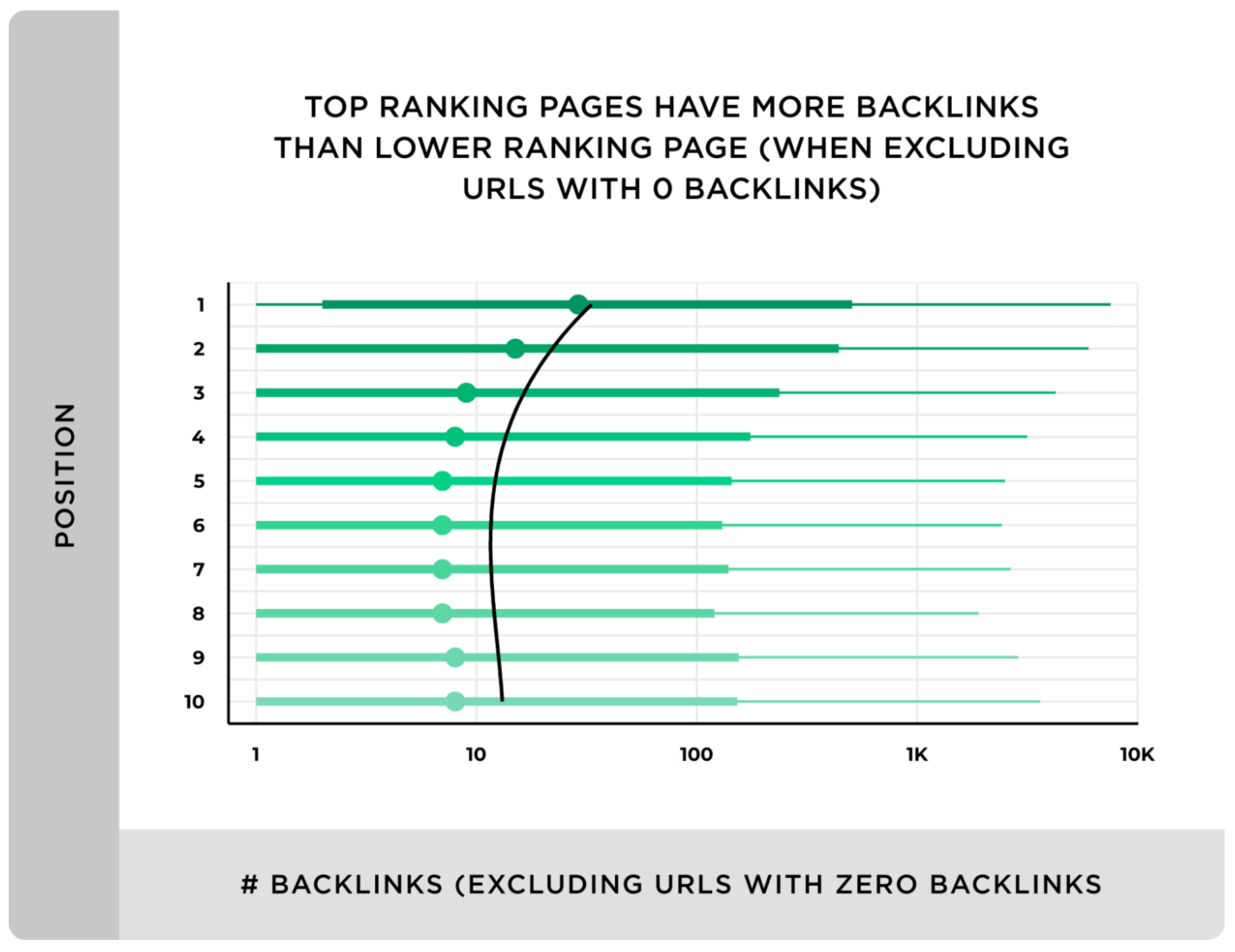
Check out this study done by Backlinko that shows the correlation of the number of backlinks to the ranking position on page 1:
(Image Source)
It’s obvious that LINKS are STILL a big driving factor behind rankings.
So for all the talk about how SEO is changing, turns out the basics are still where it’s at. And we have the DATA to prove it – We don’t rely on “a hunch” here, we look at what’s really going on in the search results.
With that said, we want to prepare for the future:
In the last few years, we’ve seen Google put a big focus on trying to understand content, search intent, and topics.
With their Hummingbird algorithm update, they tried to understand the connection between entities, topics, subtopics, and synonyms.
Google’s goal is to match a user query to the best possible answer. So if Google can rate a document based on the likelihood that it will answer the user’s question, then they have a new way of ranking documents.
This is why there is now not just a focus on the “voting mechanism” (links) but also on the actual content on the page.
Search Intent
Search engines are getting smarter. They are not looking at searches on a literal keyword by keyword basis. They’re looking at the intent behind the search and understanding that some searches have the same intent.
That’s why you no longer need to build out different pages for each keyword, but focus on building pages based around topics.
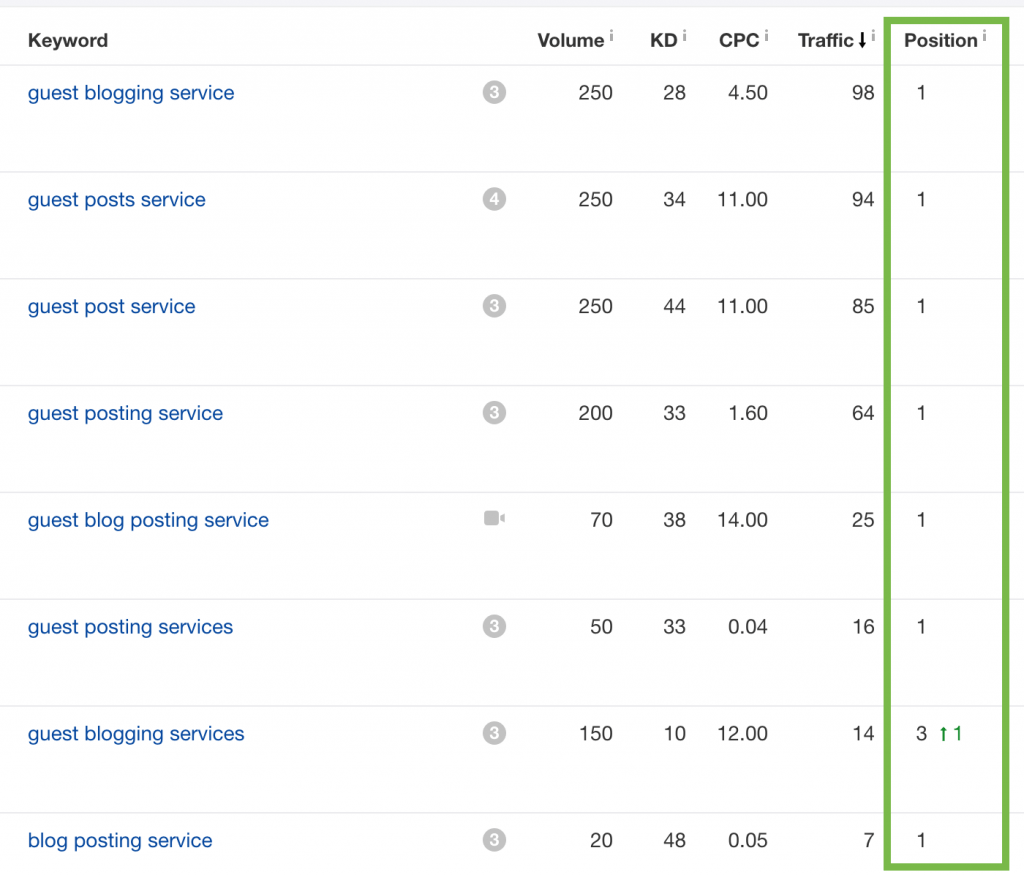
For instance, old school search engine optimization used to build out pages for each keyword: guest post service, guest packages, guest blog post packages, etc.
Google now understands those are all the same thing, so you can just create 1 page and you’ll rank for a ton of keyword variations, just like we do:
That’s why pages with longer content tend to rank better. There’s a greater chance that the page will fully explain the answer to the user query:
Overall, the best way to rank in Google now is to become an authority in your niche. When you do this, Google will “unlock the floodgates” of traffic.
So what is an authority in Google’s eyes? You need what we call the “Authority Trinity”:
- Topical Depth
Build long articles that fully answers any of the questions a user would have about that subject. - Topical Breadth
Build out lots of articles on your website answers to all the types of questions your customers have. - Authority Links:
Links are still the biggest ranking factor, but quality is much more important than it used to be. SEO is a long-term play, so we recommend focusing on getting quality links to your site.
By combining these 3 things, you will see massive increases in your traffic, just like we do with HOTH X.
Search Engine Optimization Advice: What Most People Need To Hear To Achieve SEO Success
In the past, old school SEO was really focused on 2 things: Keywords and Ranking
“If I rank #1 for my product keywords, then I win. If I don’t, then I lose.”
This is a really short-sighted view of SEO and it’s not how SEO really works today. Having this old school mindset will just set you up for failure.
If links are the biggest ranking factor, it’s going to be hard to have success because NO ONE wants to link to your product pages. It’s going to be difficult to get link equity to your site if you don’t have anything cool to link to.
The better way to do it is new school SEO:
New school SEO is more about traffic (instead of rankings), and topics (instead of keywords).
It takes into consideration the customer journey – meaning that while it’s great to rank your product pages for the end-buyer cycle keywords, the MAJORITY of the traffic is actually mid or beginner cycle keywords; Keywords that people are searching for before they are ready to buy (basically, the questions that your customers ask you every day).
-
Don’t have time to read the entire guide right now?
Let us send you the downloadable version so you can read it when it’s more convenient for you.
So when you build out that quality content, you capture way more traffic, you position yourself as an authority to build a relationship of trust with your audience, so that you can drive more traffic that actually converts to sales.
That’s exactly what this SEO strategy template is meant to do, and if you follow it, you will see massive gains in targeted traffic, leads, AND sales.
OK, so enough with the context behind it, what are the actionable steps / SEO plan to get more traffic from Google?
Here’s how to do it:
Before Your SEO Campaign Starts:
We like to start with a quick audit on your site to see if there are any underlying issues. You wouldn’t want to build your castle on sand.
If your website has dropped in the past, check and see if you have any penalties via Webmaster Tools, analytics (sudden drops in traffic), etc.
One cool tool we use is this Google penalty checker which will match up a SEMRush graph of your traffic to all the major Google updates. You can easily see if there have been major drops in traffic at the same time as an update came out which can signal what you may need to fix.
(Interested in trying SEMrush? Check them out with a 14-day free trial by clicking here.)
Some penalties are harder to recover from than others. Do NOT spend a long time trying to recover a doomed site as some just won’t recover no matter what you do. Check the Ultimate Guide To Google History, compare your dates and check out our case studies on penalty recovery for Penguin or Panda. Follow the instructions, start a new site in the meantime, or both.
Now with that said, here’s the battle plan to get started:
1. Define Your Target Audience: Who Do You Want To Attract?
Before any marketing campaign, you have to define your target audience.
You probably have some good customers that give you tons of money, don’t ask for much, and they are generally easy to deal with.
There are other customers that just aren’t a good fit. They take up a lot of time, and they don’t spend that much. They’re just not ideal for your business.
So defining who you actually want to target is going to help determine the keywords you even want to rank for and what kind of content you want to create.
Understanding your audience will help you generate tons of ideas of what to rank for. Listen to your customers, listen to your market.
When we write copy for our service HOTH Web Copy, we think about what prevents customers from buying services and we attacked it from every angle.
For example:
Customers come to us and they say, “I’m not ready to buy yet, I want to make an SEO strategy” – So BOOM, we wrote this article that says “Here’s the SEO strategy you should follow!”
Then they say, “OK I got the strategy, but I don’t know what keywords to target?”
BOOM – another article on “How To Do Easy Keyword Research“
Then they say, “OK but how can I stay safe if I’m building links?”
BOOM – another article, How To Stay Safe in SEO.
This goes on and on, and we just keep answering their questions. By doing this, we create authority and trust, so when they are ready to buy, we already have a relationship with them.
By understanding your target market, you can answer their questions and help them solve their problem. Which, in turn, drives more sales.
Once you understand who you’re going to target, then it’s time to find your keywords.
2. Keyword Research: How To Find Hundreds Of Awesome Keywords
Keyword research doesn’t have to be hard – It’s actually really easy!
You can divide keywords into 2 groups:
- Keywords that you’re already targeting
- Keywords that you’re not already targeting.
Take Advantage Of “Easy Wins” Keywords For Quick Gains!
To get easy wins in SEO, you can use keyword research tools like our own to find keywords with good search volume that you are ranking for on spot 4 or below (including page 2 of Google). Google already sees you as relevant for these terms, you just don’t rank in the top 3 for them.
By optimizing these pages and sending more links to them, you can increase your ranking a lot faster than a totally new keyword.
Use our tool to identify which keywords you’re ranking for and target those as easy wins first.
Find All Your Competitors Keywords With a Content Gap Analysis
Then, you need to find out keywords you’re NOT targeting yet, and you can do that by doing a competitive gap analysis.
Basically, you want to go out and find all your competitors’ websites. You can use both direct competitors (competitors that sell the exact same products as you) as well as indirect competitors (other businesses in your industry that don’t sell the same products but have the same audience).
Once you have a list of all these competitors, make a list of all the keywords THEY rank for and then exclude the ones that you rank for.
Now you’ll have a HUGE list of keywords to target and build out quality content (like blog posts)!
You’ll want to apply some filters to those, like excluding very high difficulty keywords (unless you have a very powerful domain), making sure they have good search volume, and putting the CPC >$1 to exclude useless keywords.
Kabam, now you have very valuable keywords that are worth targeting! Now you need to either optimize your current content for those keywords, or build new content.
Don’t be afraid of using long tail keywords. These often have greater intent and convert more leads.
3. OnPage SEO Optimization
Next, you’ll need to actually create the content and make sure your web pages are optimized.
Optimize your meta tags: Title Tags, Meta Descriptions, URL, Header tags, Images and more.
Check out our guide on onpage optimization.
The focus here should be about building out in-depth content (that’s what Google likes to see) that answers users questions. Focus on creating content that’s at least 1000+ words.
You should have a huge list of keywords from your earlier keyword research. Build out content focused on those keywords and add internal links to that content.
If you need help with your onpage optimization, you should consider our done for you technical SEO service HOTH Technical SEO.
User Experience Signals
You’ll also want to make sure that your page is easy to navigate and gives the user what they are looking for. Take a look at what is ranking and try to model that in terms of content, design, etc.
If users are landing on your page and immediately bouncing back to the SERPs, that’s a negative user experience signal. You want to make sure people are staying on your pages and continuing on your site.
Content Marketing Strategy
When you build content that helps your target customer with their problems and questions, it’s essentially attracting them to you. This is called inbound marketing, and it will get more leads into your funnel.
You can learn how that works in this blog post called “The New Way To Get More Leads & Sales“.
As a side note, you can also promote this content through channels outside of SEO like email, social media, content syndication, paid ads etc.
After you have built out the content, then you need links to drive the rankings.
-
Don’t have time to read the entire guide right now?
Let us send you the downloadable version so you can read it when it’s more convenient for you.
Optimized Product Descriptions
If you have an E-Commerce site or an online store, it’s essential to have optimized product descriptions in order to rank and bring traffic to your site.
You can learn more about optimizing your online store in this blog post titled “Shopify SEO: 5 Killer Ways To Optimize Your Store To Get More Traffic!“.
You can also get done-for-you E-Commerce product descriptions with HOTH Web Copy.
This helps separate you from your competitors with fully optimized, unique product descriptions for any/every product that’s listed in your online store.
4. Link Building Strategy
Link building sometimes gets a bad rap, but if you look at the data, it’s really what is driving rankings.
One of the most obvious problems that most sites have is underestimating the number of links they need to rank.
On top of that, many sites can get penalized for over-optimizing their anchor text and creating an unnatural profile.
So when you start on your first link building campaign, this is the plan we suggest:
1) Start with Branding / Diversity:
Since the biggest issue is that sites get hit with over-optimization, we want to start by giving your site tons of diversity. Use only natural anchor text (https://www.yoursite.com, or just your brand name as the keyword, etc) and no exact match or commercial anchors.
Build up your social properties like Facebook, Twitter, Instagram, or any that apply to your niche.
When you build social profiles, this shows that you are a real brand and you’ll be receiving both inbound links and social signals at the same time. If you’d like help registering profiles, we can do it for you with social media profile registration service.
When you create content on your site, post it to those social properties to keep natural links flowing and your social accounts active.
2) Get In-Content Diversity Links:
Get other diversified properties with in-content links. You can build out web 2.0 type properties for this and use a mix of brand, natural, and low competitions keywords / long tail variations.
3) Move on to High Power Links:
After you’ve built a substantial base, start adding in quality high-powered links with close or exact match anchors.
Never repeat the same anchor twice, just switch it up to something slightly different each time.
A great way to get these is to do guest posts on authority blogs. Here’s a great guest posting strategy.
Sometimes we see sites that have a decent amount of links, but still aren’t ranking. A lot of times that’s because they don’t have the QUALITY of links they need to be trustworthy. If this is the case, you’ll want to focus on getting in-content links from high trust publications.
Continue to add these types of links month after month while changing your anchors each time with different long tails / variations.
You’ll also want to avoid these 2 big mistakes we see:
1) Anchor Text Ratios:
The biggest problem we keep seeing is people still over-optimizing anchor text.
Stop worrying about anchor text ratios and just go all out on brand signals, naked URLs, etc. Get a ton of natural links and only use a handful of exact match anchors. I’m talking 95%+ brand / naked and <5% exact match. Google is never going to penalize a site for having too diverse a portfolio of links.
2) Don’t Give Up Too Soon:
The second biggest problem we see is people stopping or giving up on link building. Google takes time to judge your site. It can take weeks after building powerful links for movement, but based on bounce/click rates etc your site can jump around and keep moving up for months.
If it’s stuck, don’t stop and wonder why it didn’t work. You need to keep building diversified links. Our best ranking customers have ongoing link campaigns even when they are doing well. Too many people fail in their SEO campaigns by building a couple links and stopping.
As you’re building links and content, you’ll want to track how it’s all working.
5. Measure Your SEO Results
SEO definitely takes time. It would be nice if you could build links one day and see results the next, but Google just doesn’t work like that. So make sure you set your expectations that this is a long-term strategy and don’t be alarmed if it takes a few months to start seeing results.
We suggest using a combination of traffic reports from Google Analytics and keyword rank tracking.
Fluctuation is normal when you make changes, but over time you will see increases in traffic and rankings by following this strategy. The HOTH also offers a FREE Website Traffic Checker to compare stats for up to 20 different URLs.
Check out our article on tracking your SEO results here.
Extra SEO Strategy Template For Local Sites
If you are a local business or have brick and mortar locations, you’ll want to do a few extra things. Since local SEO queries bring up the map pack, you’ll want to make sure you rank there. Here’s how:
1) Set Up A Google My Business Page:
Set up your Google My Business Page correctly so you can rank in the 3 pack.
2) Audit Citations:
This is the #1 thing that will hold you back in local. Make sure you always do a local citation audit before doing anything. This will also tell you which citations you’re missing. Clean up and fix your local citations if necessary.
3) Build citations & links:
Get the local citations & links that your top ranking competitors have from industry sites, and ego directories. Keep building these until you have crushed your competitors.
Conclusion
You can see how effective a well-rounded SEO strategy can be if you take all these things into consideration.
By following this plan, you’ll set yourself up for massive success. This detailed and thorough process is the exact same one that we use for our managed SEO service, HOTH X. With HOTH X, you get your own campaign manager who will essentially be your personal SEO consultant.
Our team of digital marketing experts can help you get more traffic and sales. We offer SEO solutions for different industries across the country. Each has witnessed their businesses grow after working with us.
And, as usual, if you need help with anything please contact us!
Leave a comment