
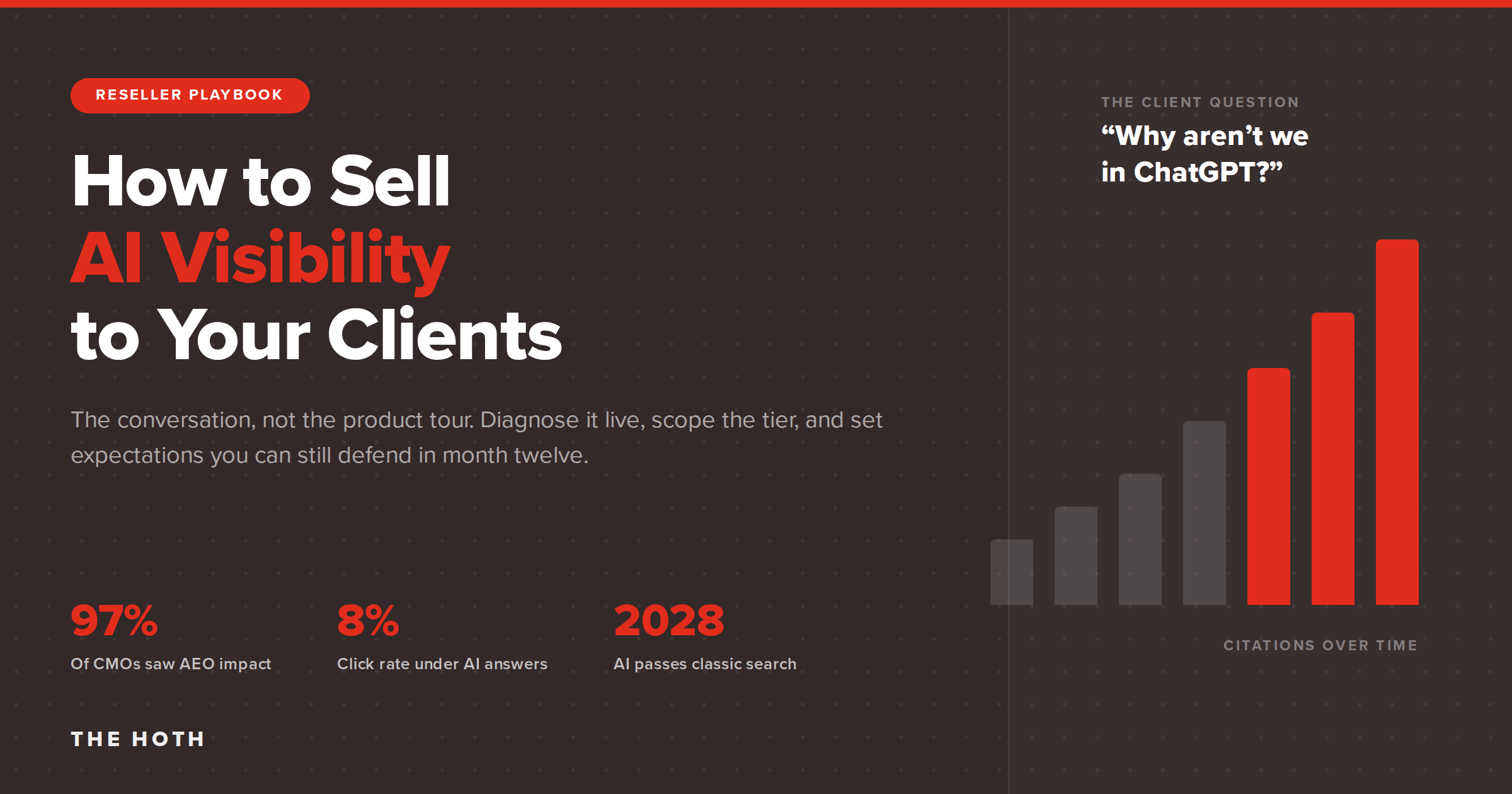

Selling AI visibility means translating one client question, “why don’t we show up in ChatGPT,” into a diagnosis they can see, a scope they can approve, and a report they can read. The pitch is not a product tour. It is a conversation about where buying decisions are being made and whether your client is in the room when it happens.
A client forwards you a screenshot. They asked ChatGPT to recommend the best provider in their category and city, and the answer named three competitors. Not them.
Then comes the question you have to answer on the spot: why aren’t we in there, and what are you going to do about it?
If you resell SEO, you are fielding this call a lot more often than you were six months ago. The tactics are not the hard part. Earned media, content refreshes, reviews, and authority links are work you already understand or already outsource. The hard part is the conversation: explaining the problem in language a business owner accepts, showing proof in the room, scoping something you can price, and setting expectations you can still defend twelve months from now.
This is the script for that conversation. It covers how to answer the ChatGPT question in plain English, how to run a live diagnosis in front of the client, how to scope and tier the engagement, what to promise and what to refuse to promise, how to report on it month to month, and how to handle the three objections that kill these deals. AI Discover is the program doing the fulfillment behind most of it, but the sale is yours, under your brand.
Why Are Your Clients Suddenly Asking About AI Visibility?
Clients are asking because the behavior changed and the budgets followed. Buyers now research in ChatGPT, Gemini, Perplexity, and Google AI Overviews before they ever open a results page, and enterprise marketing teams have already moved money to keep up. Your client is not being early. They are catching up.
The click math is the clearest evidence. Pew Research Center tracked the browsing of 900 US adults and found that when an AI summary appeared, people clicked a traditional result only 8% of the time, compared with 15% when no summary was present. Clicks on the sources inside the summary were rarer still, at roughly 1% of visits.
So the answer surface moved, and the click did not follow. That is the whole problem in one sentence, and it is the sentence your client already feels even if they cannot name it.
Spending has shifted accordingly. Conductor surveyed more than 250 CMOs and digital leaders and found that 97% reported a positive impact from answer engine optimization in 2025, and 94% planned to increase that investment in 2026. A separate 2026 survey of digital marketing practitioners found 65% naming AI-driven search change as their single biggest challenge.
For a reseller, that combination is the opportunity. Demand exists, budget exists, and most agencies still cannot deliver against it. If you can have a competent conversation about AI visibility and put a real program behind it, you are ahead of the shop down the street that is still selling rankings alone.
How Do You Answer “Why Aren’t We Showing Up in ChatGPT?”
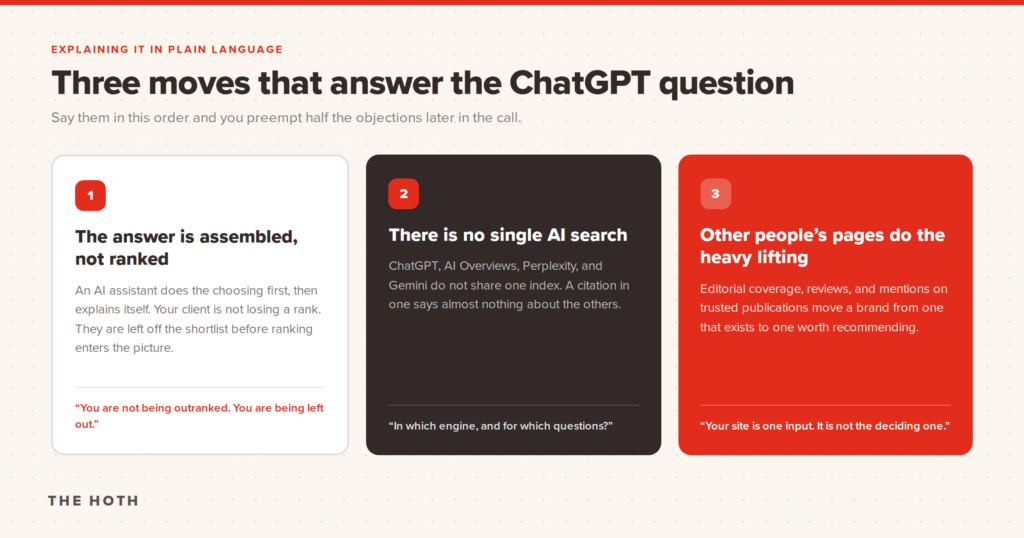
Explain it in three moves: AI answers are assembled from sources the model trusts rather than from a ranked list, each engine draws on a different index so a citation in one is not a citation in all, and what other people publish about the brand carries more weight than what the brand publishes about itself. Skip the acronyms.
Here is the version that lands with a business owner who does not care what an LLM is.
Move one: the answer is assembled, not ranked.
Google used to hand people a list and let them choose. An AI assistant does the choosing first, then explains itself. It builds the answer out of sources it already considers credible on that topic. Your client is not losing a rank. They are being left out of the shortlist before ranking ever enters the picture.
Move two: there is no single AI search.
ChatGPT, Google’s AI Overviews and AI Mode, Perplexity, Gemini, and Claude do not share one index. Being cited in one says almost nothing about the others. That is why the honest answer to “are we in AI?” is always “in which one, and for which questions?” Our engine-by-engine guide to AI citations breaks down how each one sources its answers, and it is worth reading before you take this meeting.
Move three: other people’s pages do the heavy lifting.
This is the part clients find counterintuitive and the part that sells the work. A brand’s own website is one input. Editorial coverage, review profiles, and mentions on publications the model already trusts are what move a brand from “a company that exists” to “a company worth recommending.” That is why AI visibility work leans on earned media and digital PR rather than on another round of on-page tweaks.
Say it in that order and you have preempted half the objections later in the call.
How Do You Diagnose AI Visibility in Front of the Client?
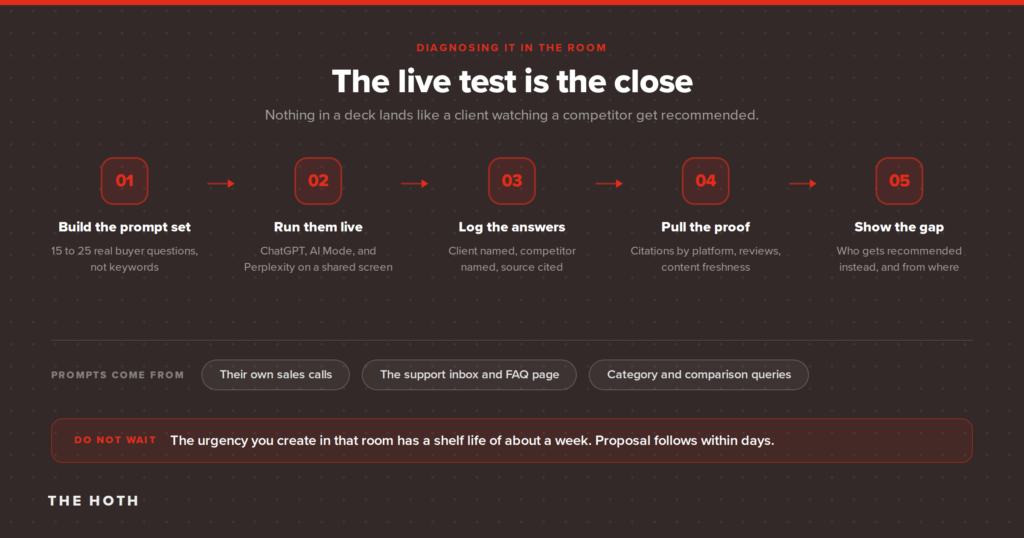
Run the prompts live. Build 15 to 25 questions a real buyer would ask, run them in the major engines while the client watches, and log who gets named. Nothing you can put in a deck lands as hard as a client watching a competitor get recommended in real time.
The live test is the close. Do it on a shared screen, not in a PDF you email afterward.
Building the prompt set
Do not use keywords. Use questions, phrased the way a buyer types them into a chat window. Pull them from three places:
- The client’s own sales calls. What do prospects ask before they buy?
- Their support inbox and FAQ page. Those are real buyer questions already written down.
- Category and comparison prompts. “Best X in [city],” “X vs Y,” “is X worth it,” “who should I hire for X.”
Fifteen to twenty-five prompts is enough for a first read. Run each one in ChatGPT, Google AI Mode, and Perplexity at minimum, and log three columns: was the client named, was a competitor named, and what source did the answer cite.
What proof to pull before the meeting
- Citation counts by platform, so you can show that visibility is uneven rather than binary.
- The domains getting cited instead. Usually a mix of review sites, publications, and forums, which sets up the earned media conversation.
- The client’s review profile and rating, since AI systems check reputation signals before recommending a business.
- Content freshness on their most important pages. Stale pages are a recurring reason a brand drops out of answers.
Ongoing tracking is a separate question from the one-time audit. Our guide on tracking brand mentions across ChatGPT, Perplexity, and AI Overviews covers the manual and automated approaches. On a managed program, the Atlas dashboard handles this and gives you something to screenshot every month.
One warning. Do not run the diagnosis and then leave a gap before the proposal. The urgency you create in that room has a shelf life of about a week.
How Do You Scope the Engagement and Recommend a Tier?
Scope on three variables: how competitive the category is, how much authority the brand already has, and how fast the client expects to see movement. Those three answers set the tier. AI Discover starts at $775 per month with a three-month minimum, and capacity is capped per quarter.
Ask these before you quote anything.
How competitive is the category?
A regional service business competing against four local players needs a fraction of what a national ecommerce brand needs. Competitive verticals where AI recommendations move real money, legal, financial services, healthcare, SaaS, and ecommerce, need more placement volume and more sustained effort.
What authority already exists?
A brand with an established backlink profile and a healthy review presence is closer to being citable than a brand starting from a Domain Rating in single digits. Pull the baseline before you scope, because starting position drives both the tier and the timeline you promise.
How fast do they expect movement?
A client who wants to see something in ninety days needs a heavier front-loaded program than one running a twelve-month brand play. Say so out loud. Speed costs money in this channel the same way it does in link building.
Ala carte or managed?
If you have an in-house strategist who knows which signals to pull, ala carte AI visibility products let you order exactly what you need: Exclusive Media Links, Content Refresh, Review and Reputation Management, and the rest. If you would rather hand the strategy off entirely, AI Discover bundles those channels under a dedicated strategist who runs them together.
Most resellers should default to the managed program for the first few AI visibility clients, then move to ala carte once they know the playbook. It is easier to defend a single monthly retainer line than to justify eight separate deliverables to a client who does not yet understand the channel.
On pricing your side of it, most HOTH resellers run 40% to 60% margins on wholesale. If you are building this into a package rather than selling it standalone, our guide to SEO reseller packages and what they cost covers the bundling math, and the SEO retainer guide covers how to structure it as recurring revenue instead of a project.
What Timeline Should You Promise, and What Should You Never Promise?
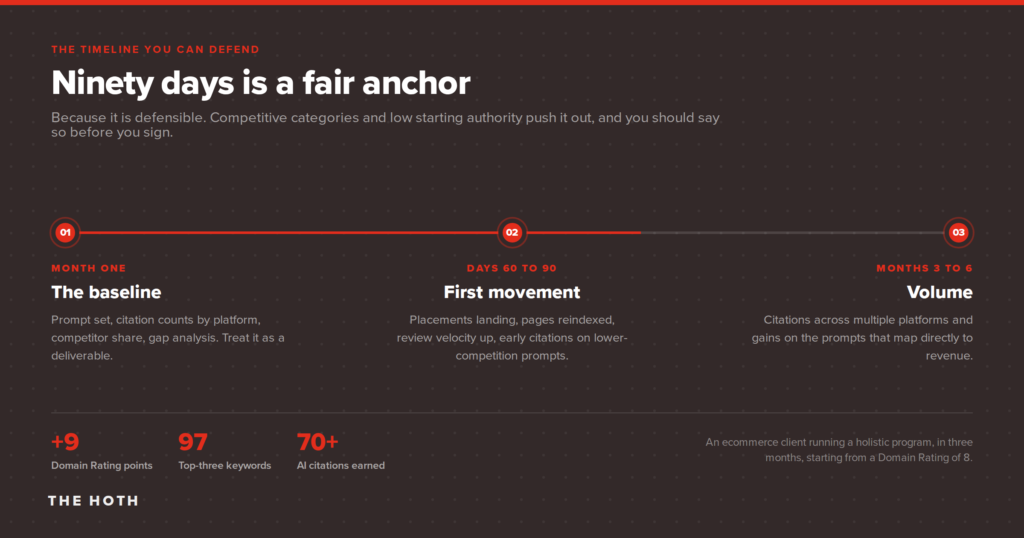
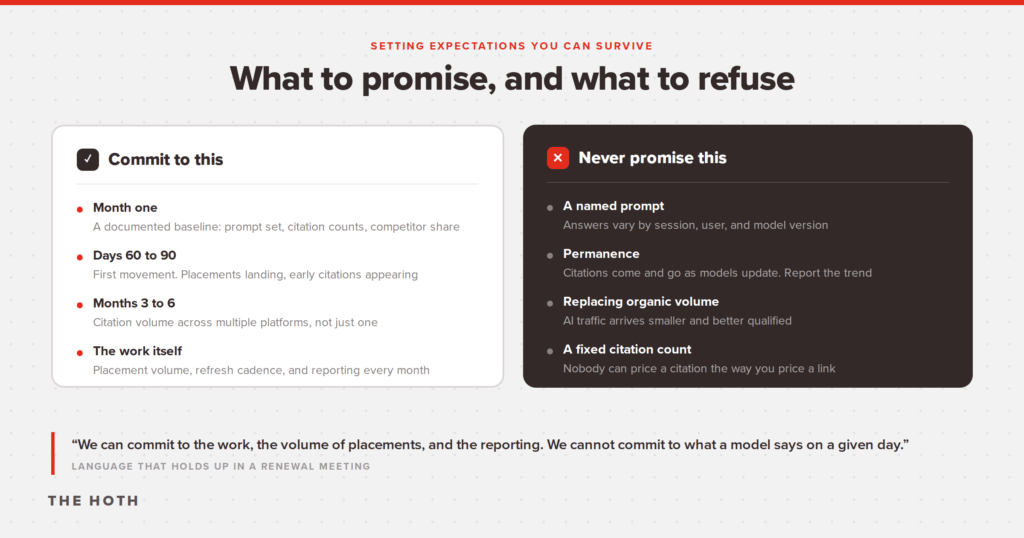
Promise a baseline in month one, early movement in sixty to ninety days, and meaningful citation volume by month three to six. Never promise a specific position in a specific engine, a citation on a named prompt, or that any citation will hold month over month. Those are outside anyone’s control.
What you can promise
- Month one: a documented baseline. Prompt set, citation counts by platform, competitor share, and the gap analysis. This is a deliverable, and it should be treated as one.
- Days 60 to 90: first movement. Placements landing, refreshed pages reindexed, review velocity improving, and early citations appearing on lower-competition prompts.
- Months 3 to 6: volume. Citations across multiple platforms rather than one, and improvement on the prompts that map directly to revenue.
Ninety days is a fair anchor because it is defensible. An ecommerce client running a holistic program added 9 points of Domain Rating, 97 top-three keywords, and more than 70 AI citations across ChatGPT and Google AI Overviews in three months, starting from a Domain Rating of 8. That is the shape of a good first quarter, not a guarantee of one.
What you should never promise
- A citation for a named prompt. Answers vary by session, user, and model version. Promise the program, not the sentence.
- Permanence. Citations come and go as models update. Frame the metric as trend, not as a trophy.
- That AI traffic will replace organic traffic volume. It will not, at least not this year. It arrives smaller and better qualified.
- A fixed citation count. Nobody can price a citation the way you can price a link.
Here is language that holds up in a renewal meeting: “We can commit to the work, the volume of placements, and the reporting. We cannot commit to what a model says on a given day, and any agency telling you otherwise is guessing.” Clients respect that more than a number you will have to walk back in month seven.
How Do You Report on AI Visibility Month to Month?
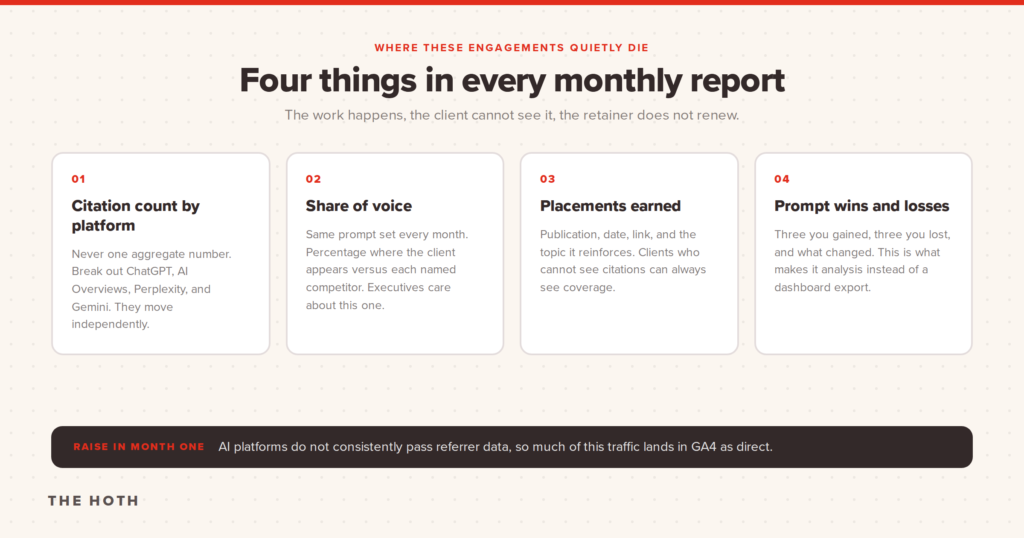
Report four things every month: citation count by platform, share of voice against named competitors, placements earned, and prompt-level wins and losses. Add one line explaining why analytics undercounts AI traffic, so the client is never surprised by the gap between your report and their dashboard.
Reporting is where most AI visibility engagements quietly die. The work happens, the client cannot see it, and the retainer does not renew. Measurement difficulty was one of the top challenges CMOs named in Conductor’s survey, which tells you it is not a small-agency problem.
The four required sections
- Citation count by platform. Not one aggregate number. Break it out by ChatGPT, AI Overviews, Perplexity, and Gemini, because they move independently and the breakout demonstrates you are tracking properly.
- Share of voice against named competitors. Run the same prompt set every month and report the percentage of prompts where the client appears versus each competitor. This is the number executives care about.
- Placements earned. The concrete deliverable. Publication, date, link, and what topic it reinforces. Clients who cannot see citations can always see coverage.
- Prompt-level wins and losses. Three prompts you gained, three you lost, and what changed. This is what makes the report feel like analysis instead of a dashboard export.
The tracking caveat you should raise first
Much of this traffic does not identify itself. As Semrush notes, many AI clicks land in GA4 as direct traffic because AI platforms do not consistently pass referrer data, which means your client is almost certainly getting more AI traffic than their analytics shows. Semrush also projects AI search visitors will surpass traditional search visitors by 2028.
Raise this in month one, not in month five when the client asks why the numbers do not line up. For a fuller framework on assigning dollar value to work that does not always produce a tracked session, see our guide on measuring the ROI of AEO.
Every report ships unbranded, so it goes out under your logo. Your client never sees a vendor name.
How Do You Handle the Three Objections That Kill These Deals?
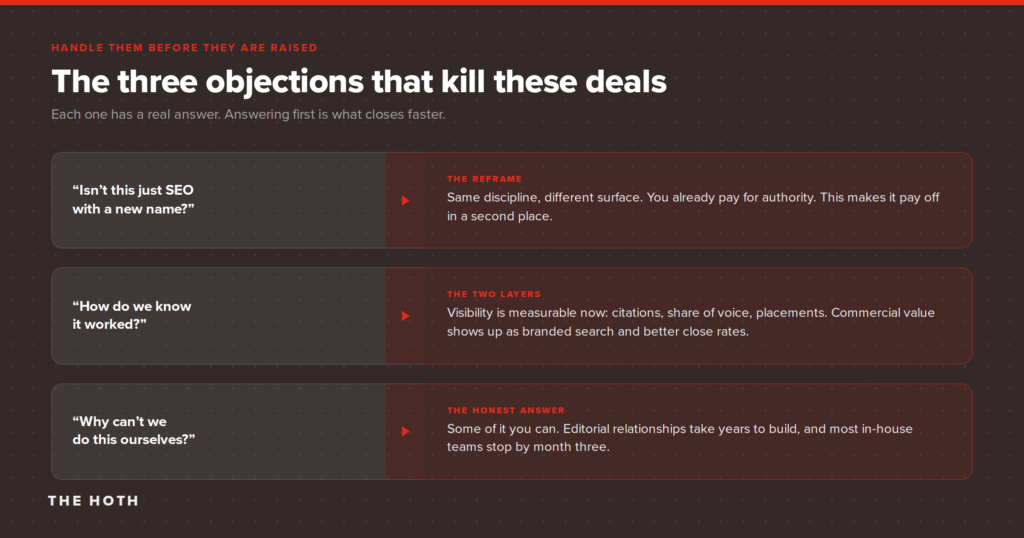
The three that end deals are “isn’t this just SEO again,” “how do we know it worked,” and “why can’t we do this ourselves.” Each has a real answer. Answer them before the client raises them and the deal closes faster.
“Isn’t this just SEO with a new name?”
Partly yes, and saying so builds credibility. The authority signals overlap, so a good SEO program already helps. What is different is where the work concentrates.
Traditional SEO optimizes a page to rank. AI visibility work concentrates on being cited, which depends more heavily on third-party validation, review sentiment, content freshness, and structured, extractable answers. A brand can rank well and still be absent from AI answers, which is exactly the situation most clients are calling you about.
Then reframe it: “It is the same discipline pointed at a different surface. You are already paying for authority. This makes that authority pay off in a second place.”
“How do we know it worked?”
This is the objection that deserves the most preparation, because the honest answer is that attribution here is harder than in search, and pretending otherwise costs you the account later.
Answer it in two layers. Layer one is visibility, which is directly measurable: citation counts, share of voice, and placements. Layer two is commercial, which shows up as branded search lift, direct traffic growth, and better close rates because prospects arrive already convinced.
The commercial layer has support. Adobe’s analytics data for May 2026 showed AI-referred traffic to US retail sites converting 54% better than non-AI sources, with those visitors 15% more engaged, spending 53% longer on site, and browsing 23% more pages per visit. You can read Adobe’s breakdown of the trend if the client wants the source.
The HOTH’s own properties show the same pattern from the inside: 354% AI traffic growth and 9x higher conversion rates from AI-referred visitors. That is our result on our own sites, not a client campaign, and it should be presented that way.
The point to land: fewer visitors, further along in the decision. Judge the channel on quality, not volume.
“Why can’t we just do this ourselves?”
They can do some of it. Structuring content, cleaning up schema, and asking for reviews are all in reach for a competent in-house team, and admitting that makes the rest of your answer credible.
What they cannot do in-house is the part that moves the needle: earning editorial placements on publications the models already trust. That requires relationships with editors and publishers, and it takes years to build. It is also the piece that gets a brand into ChatGPT’s answers when their own site alone will not.
The second thing they cannot do easily is sustain it. AI visibility is not a project with an end date. It is monthly placement volume, quarterly content refreshes, and continuous review generation, tracked across four or five platforms that each behave differently. Most in-house teams start that and stop by month three.
What Does This Look Like as a White Label Line?
AI Discover bundles earned media, exclusive media links, digital PR, content refresh, and review management under one strategist, with Atlas tracking citations across AI platforms. It is 100% private label, so the client relationship, the pricing, and the brand all stay yours.
The fulfillment side is not the interesting part of this article, but you need to know what you are selling.
- Earned media and digital PR. Editorial placements on publications AI models draw from. This is the engine of the program.
- Exclusive Media Links. High-authority editorial placements that build citation density.
- Content Refresh. Keeping key pages current, which matters because AI systems favor fresh sources.
- Review and Reputation Management. Reputation signals feed directly into whether a brand gets recommended.
- Atlas tracking. Citation monitoring across AI Overviews, search, and LLM responses, so you have something to report.
Everything ships unbranded. No logos, no phone numbers, no “powered by” line in the footer. If you also want the traditional side covered under the same roof, Managed SEO handles Google and AI together, and our rundown of the easiest HOTH products to resell shows how the ala carte pieces layer into existing accounts.
For proof the reseller model itself works at scale, a regional ad agency that started with a single link outreach order doubled its year-over-year net income and now runs results for 28-plus client domains through the program. More examples across verticals live in our case study library, and several of the recent ones include AI citation data you can put in front of a prospect.
One last note on timing. Clients are also starting to ask about AI agents that shop and buy on a customer’s behalf, which is a related but separate technical problem. If you sell to ecommerce, read up on agentic commerce before that question catches you off guard the way the ChatGPT question did.
Start Selling AI Visibility Under Your Brand
The agencies winning this conversation are not the ones with the best explanation of how language models work. They are the ones who can run the diagnosis live, scope a real program, set expectations they can survive, and show a client something legible every month.
You bring the client relationship. We handle the fulfillment, and the client never sees us. See what AI Discover covers, or book a call to talk through how to package it for the accounts you already have.
Frequently Asked Questions
What is AI visibility, in one sentence a client will understand?
AI visibility is whether a brand gets named and cited when someone asks an AI assistant like ChatGPT, Gemini, Perplexity, or Google AI Overviews for a recommendation in that category.
Can you guarantee a client will appear in ChatGPT?
No, and no agency can. AI answers vary by session, user, and model version. You can commit to the work, the placement volume, and the reporting, and you can show citation trends over time. Guaranteeing a specific answer is a promise you will have to break.
How long before a client sees results from AI visibility work?
Expect a documented baseline in month one, early movement in 60 to 90 days, and meaningful citation volume across multiple platforms by month three to six. Competitive categories and low starting authority push that timeline out.
How much should an agency charge for AI visibility services?
AI Discover starts at $775 per month wholesale with a three-month minimum. Most HOTH resellers run 40% to 60% margins, so retail pricing typically lands between roughly $1,300 and $2,000 per month at the entry tier, higher for competitive verticals and faster timelines.
Is AI visibility work separate from SEO, or part of it?
It overlaps but is not identical. Both depend on authority. AI visibility leans harder on third-party editorial coverage, review sentiment, content freshness, and extractable answer formatting, which is why a brand can rank well in Google and still be missing from AI answers.
Why does the client’s analytics show less AI traffic than the report?
AI platforms do not consistently pass referrer data, so a large share of AI-driven visits land in GA4 as direct traffic. Raise this in the first month so the gap is expected rather than alarming.
Leave a comment