
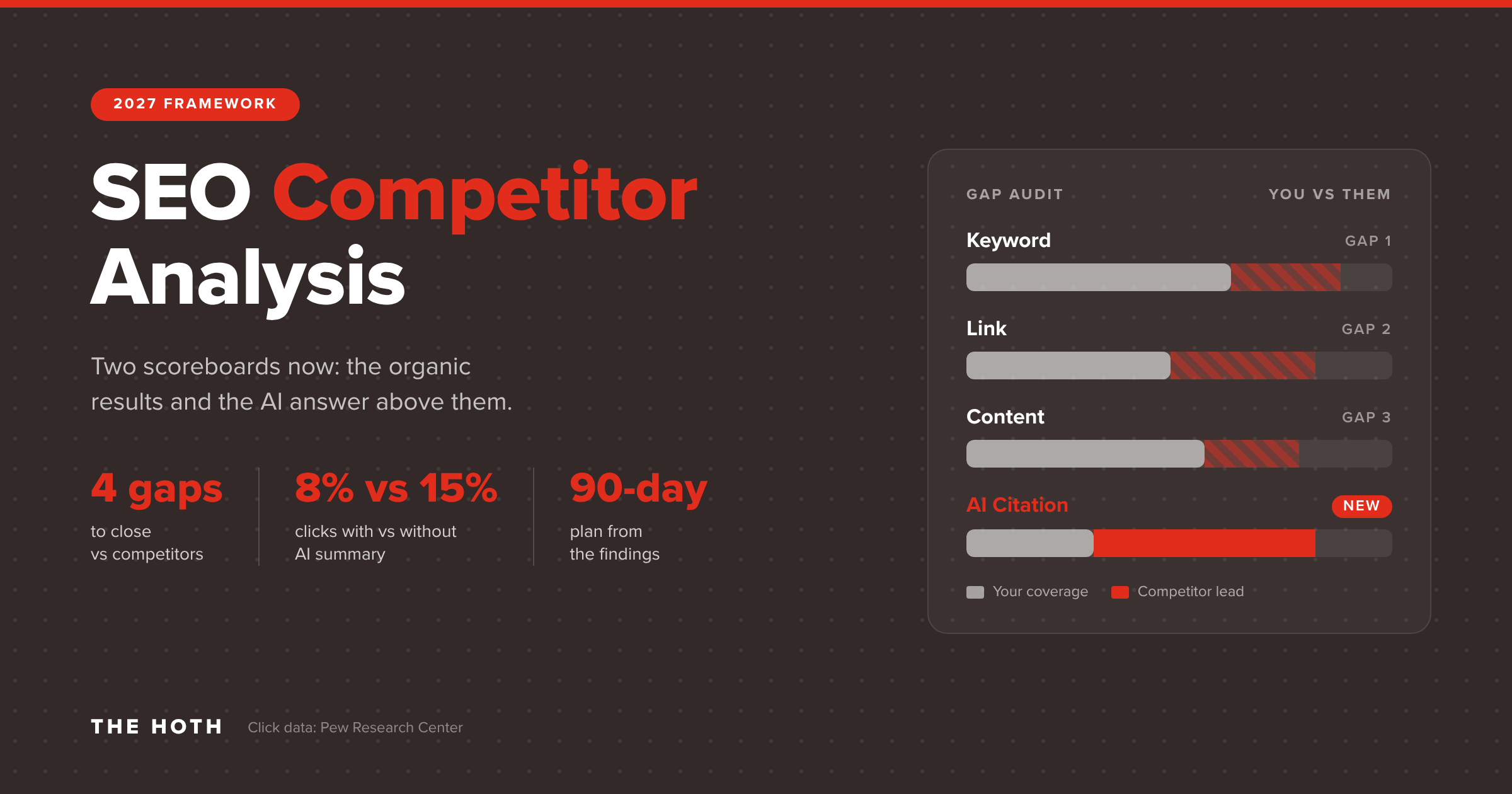

An SEO competitor analysis is a side-by-side audit of the sites that win the searches you want, done to find four gaps you can close: the keywords they rank for that you don’t, the links they’ve earned that you haven’t, the content they publish that you’re missing, and the AI answers that cite them instead of you. The output is a short, prioritized list of fixes, not a spreadsheet of everything a competitor does.
You already know who your competitors are. You’ve watched their names sit above yours on Google for months. What you probably don’t have is a clear answer to the question that matters: what are they doing that you aren’t, and which of those things is worth your time?
That’s the job of an SEO competitor analysis: turning a vague sense of “they’re beating us” into a ranked list of moves.
The process has changed in one big way over the last two years. Ranking on page one used to be the finish line. Now there’s a second scoreboard above the organic results: the AI Overview, plus AI Mode and assistants like ChatGPT, deciding which brands to name. A competitor can lose to you in the blue links and still win the answer.
This guide gives you a working framework built around four gaps: keyword, link, content, and AI citation. You’ll learn how to pick the right competitors, how to measure each gap with free or common tools, and how to turn what you find into a 90-day plan.
What does an SEO competitor analysis include in 2027?
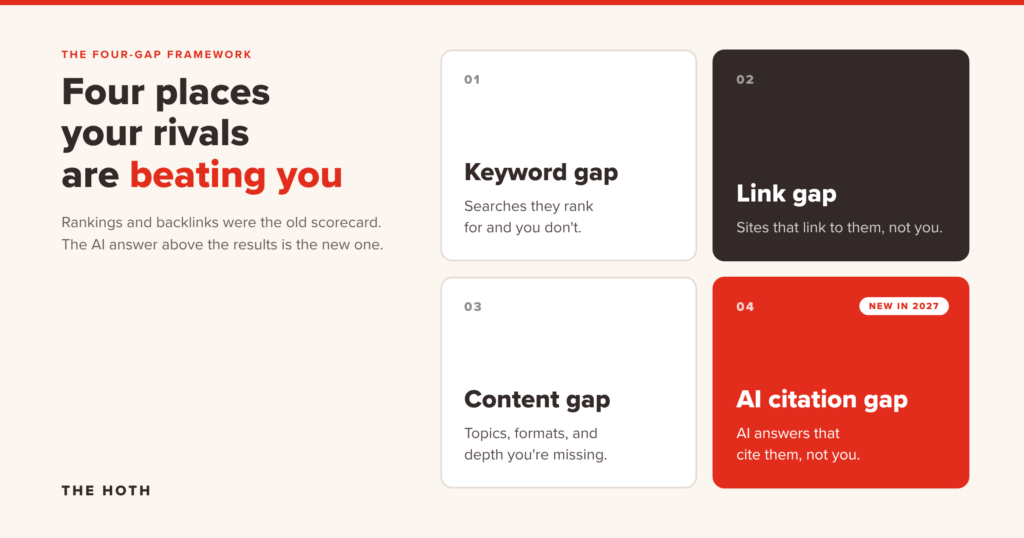
A 2027 SEO competitor analysis covers four gaps. A keyword gap shows the searches competitors rank for that you don’t. A link gap shows the sites that link to them but not to you. A content gap shows the topics and formats they cover that you’re missing. An AI citation gap shows the queries where AI answers cite them instead of you.
The older version of this process focused on rankings, backlinks, on-page SEO, and technical health. All of that still matters, but it misses the layer of search where a growing share of buying research now happens.
When Pew Research Center tracked the Google searches of 900 U.S. adults, people clicked a traditional search result on 8% of visits when an AI summary appeared, compared with 15% when it didn’t. Clicks on links inside the summary itself happened on just 1% of visits. If your competitor is the brand that summary names, they’re getting exposure your rank tracker will never show you.
So the framework has four parts:
- Keyword gap: the searches that send competitors traffic and send you nothing.
- Link gap: the referring domains that vouch for them and haven’t heard of you.
- Content gap: the topics, page types, and depth they offer that you don’t.
- AI citation gap: the queries where AI answers cite or recommend them and leave you out.
Before you measure any of them, you need the right competitors.
How do you identify your real SEO competitors?
Your SEO competitors are the domains that keep showing up for the searches you want to win, and they aren’t always the businesses you compete with for customers. Build three lists (who ranks for your money keywords, who AI answers cite for those same queries, and who you lose deals to), then pick three to five domains that appear on more than one list.
The fastest way to waste a competitor analysis is to study the wrong competitor. A national brand with a decade of links isn’t a useful benchmark for a regional business, and neither is a hobby blog that sells nothing.
List 1: Search competitors
Write down your 10 to 20 most valuable keywords, the ones tied to revenue rather than vanity traffic. Search each one and note every domain on page one. The domains that keep reappearing are your search competitors.
For larger sites, a tool saves hours. Our free competitor organic search checker shows who competes with you for similar keywords, and paid platforms like Ahrefs and Semrush have organic competitor reports that do the same at scale. If you work in Semrush, our walkthrough on running a competitor analysis in Semrush covers the exact reports.
List 2: AI answer competitors
Run the same priority queries and look at which brands the AI Overview cites. Then repeat the check in ChatGPT or Perplexity for your top five queries. You’re looking for names that keep appearing in answers, even if they’re nowhere near page one. We’ll come back to this list in the AI citation section.
List 3: Business competitors
Ask your sales team who you lose deals to. Those names may or may not show up in search, and that’s useful either way. A business competitor that’s invisible in search is an opening. A search competitor you never meet in a sales conversation might be a publisher or a directory, which makes it a link or partnership target rather than a rival.
Pick three to five domains that land on at least two lists and sit within reach of your size. A competitor that’s a little bigger than you is the sweet spot: you can learn from what got them there, and the gap is small enough to close.
How do you run a keyword gap analysis?
Enter your domain and your chosen competitors into a keyword gap tool and sort the results into three groups: missing keywords (they rank, you don’t), weak keywords (you both rank, they rank higher), and strong keywords (you lead). Then filter the missing and weak groups by search intent and business value before you plan any new content.
A keyword gap tool compares the ranking keyword sets of several domains at once. Our free keyword gap analysis tool compares your site against up to three competitors. Ahrefs calls its version Content Gap, and Semrush calls it Keyword Gap. They all sort keywords into the same three buckets:
- Missing: keywords at least one competitor ranks for where you don’t rank at all.
- Weak: keywords you both rank for where the competitor sits higher.
- Strong: keywords where you already outrank them.
Most people jump straight to the missing list and start writing. Slow down. A raw export can run to thousands of rows, and plenty of them are noise: branded terms, accidental rankings, or keywords with no commercial value to you.
Filter before you plan:
- Intent: Does the searcher want something you sell, or a topic your buyers research before they buy?
- Value: Would ranking for this term plausibly lead to a lead, a sale, or a sign-up?
- Reach: Do the pages ranking now have link profiles you could realistically match?
The weak list is often where the fastest wins hide. You already have a page Google considers relevant. It may only need more depth, a clearer answer near the top, or a few quality backlinks to move up.
Key point: A keyword gap tells you where competitors win. It doesn’t tell you why. The why almost always lives in one of the next three gaps: links, content, or the AI layer.
How do you find a link gap without copying bad links?
A link gap analysis lists the domains that link to two or more of your competitors but not to you. Those sites have already shown they’ll link to businesses like yours, which makes them your warmest outreach targets. Filter the list for relevance and editorial quality, and skip any link that only exists because someone paid for it to pass ranking credit.
Start by running each competitor through a backlink checker. Our free backlink checker shows referring domains, anchor text, and whether each link is followed. For a true gap view, use a link intersect report in Ahrefs or the backlink gap report in Semrush, which list the domains linking to several competitors but not to you.
Then filter hard. Not every competitor link is worth chasing, and some are worth avoiding. Google’s spam policies name buying or selling links that pass ranking credit, excessive link exchanges, and low-quality directory links as link spam. If a competitor’s profile is propped up by those, matching it is a liability, not a strategy.
The links worth pursuing are the ones that would make sense even if search engines didn’t exist:
- Industry publications that cover businesses in your space
- Resource and roundup pages that list providers like you
- Trade and local associations, partners, and suppliers
- Media coverage earned through data, expertise, or news, which is the focus of Earned Media
Our full playbook on using competitor backlinks to your advantage goes deeper on outreach. The point here is that the link gap feeds the AI layer, too, because the publications that link to a brand tend to be the same ones AI answers draw from.
What closing a link gap looks like
A moving company serving Kansas City and Denver came to us up against national chains with Domain Ratings above 50. Their site and reputation were solid. What they lacked was authority.
Through our managed SEO program, we built 210+ backlinks from 39 unique referring domains, drawn from real estate blogs, home service publications, and local lifestyle sites. Links went to the core location pages first, then spread to service pages to build cluster authority without overloading any single URL.
Top 3 rankings grew from 55 to 131, including #1 for “moving company kansas city,” and monthly traffic value reached $18,244. The same authority started showing up in AI answers, too: 69+ brand mentions across Google AI Mode and AI Overviews. Closing the link gap moved both scoreboards at once.
What is a content gap, and how is it different from a keyword gap?
A keyword gap is a list of search terms. A content gap is the reason you’re missing them: a topic you haven’t covered, a page type you don’t offer, or a page that’s thinner or older than the competitor’s. Closing a content gap means building or rebuilding pages, not just targeting new terms.
Open the top three competitor pages for each priority keyword and compare them with yours on four things:
- Topic coverage: Which subtopics and questions do they answer that you skip?
- Format: Is the ranking page a guide, a tool, a template, a comparison, or a video?
- Depth and evidence: Do they show original data, screenshots, examples, or expert input?
- Freshness: When was the page last meaningfully updated?
Format is the gap people miss most, and the results for “seo competitor analysis” show it clearly. In an Ahrefs snapshot from October 15, 2026, the organic results were dominated by tool pages and guides that offer a free template, and the AI Overview cited three YouTube walkthroughs. A plain text guide with no template and no video is missing two formats the results reward.
Coverage and depth are where you earn the right to outrank. Google’s guidance on helpful content asks whether a page offers original information or analysis and whether it provides substantial value compared with the other pages in the results. A content gap analysis lets you answer that question with evidence instead of a hunch.
For a deeper walkthrough of this step, see our guide to running a content gap analysis. If the gap sits on pages you already have, a Content Refresh is often faster than a rewrite.
How do you measure the AI citation gap?
Take your 20 most valuable commercial queries, record which domains the AI Overview cites for each, and compare that list with the organic top 10. Sort each query into one of four buckets: ranking and cited, ranking but not cited, cited but not ranking, or neither. Your citation gap is the share of your ranking queries where AI doesn’t cite you.
This is the newest part of the framework, and the one most competitor analyses still skip. It answers a simple question: when your buyers ask AI, who does it recommend?
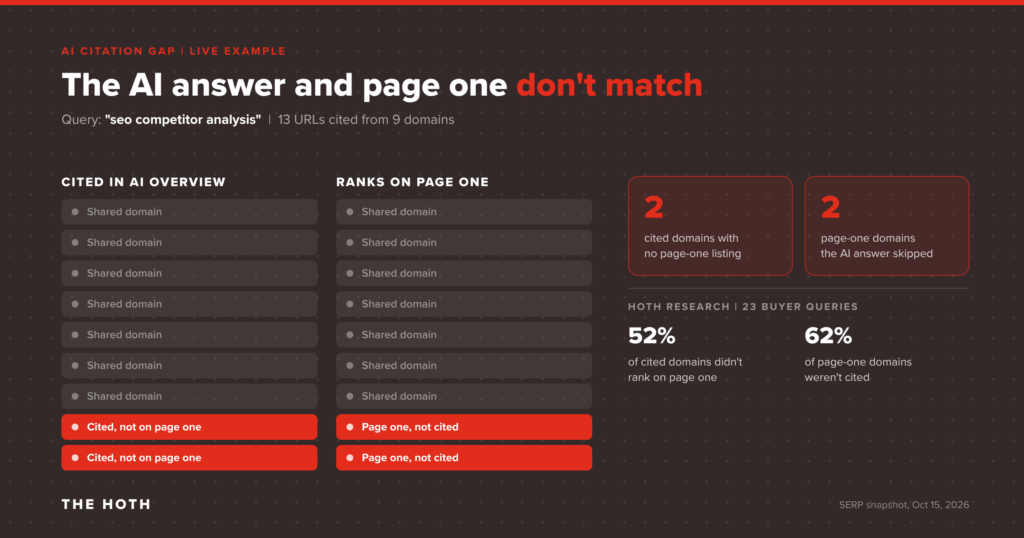
The answer often doesn’t match the rankings. For our citation gap research, we studied 23 buyer queries and found that 52% of the domains cited in AI Overviews didn’t rank on page one for that query, while 62% of page-one domains weren’t cited at all.
The keyword this article targets shows the same pattern. In the October 15 snapshot, the AI Overview for “seo competitor analysis” cited 13 URLs from nine domains. Two of those domains, an agency blog and YouTube, had no page-one organic listing. Meanwhile, two domains that did hold page-one spots weren’t cited at all.
How to run the check
- Choose your queries. Start with the 20 commercial searches that matter most: cost, comparison, “best,” and “how to choose” queries.
- Record the citations. For each query, note whether an AI Overview appears and which domains it cites. Date every check, because citations shift.
- Record the organic top 10. Note every domain ranking on page one for the same query.
- Bucket your domain. Ranking and cited, ranking but not cited, cited but not ranking, or neither.
- Calculate the gap. Divide the ranking queries where you aren’t cited by your total ranking queries.
Then repeat steps 2 through 4 for each competitor to see which rivals AI favors, and on which kinds of queries.
There’s no secret technical switch to flip here. Google’s documentation on AI features says a page only needs to be indexed and eligible to show with a snippet to appear as a supporting link, with no special optimization required. That means the citation gap usually comes down to the same things as the other three gaps: clear answers on the page, authority from sites AI trusts, and mentions in the publications it reads.
Measurement is getting easier, too. Google’s generative AI performance report in Search Console, rolled out to all websites as of August 31, 2026, shows impressions from AI Overviews and AI Mode by page. It won’t show competitor data, but it does tell you which of your pages AI is already surfacing. Our guide to AI visibility reporting covers how to fold those numbers into your monthly reporting.
If you want this tracked and worked on continuously, that’s what AI Discover is built for: it earns mentions in the publications AI models draw from and tracks where your brand appears across AI Overviews, search results, and LLM responses.
How do you turn the four gaps into a 90-day plan?
Score every gap on expected impact and effort, then work the high-impact, low-effort items first. Most 90-day plans end up with a few page upgrades from the weak keyword list, one or two new pages from the content gap, a short list of link targets, and a citation baseline you re-check monthly.
A competitor analysis that ends in a 40-tab spreadsheet isn’t finished. The deliverable is a short list of moves with owners and dates. Here’s the scorecard we use to get there:
| Gap | What to record | Typical first move | Effort |
|---|---|---|---|
| Keyword | Missing and weak keywords, filtered by intent and value | Upgrade the pages on your weak list | Low to medium |
| Link | Domains linking to two or more competitors but not you | Outreach to the 10 most relevant targets | Medium |
| Content | Topics, formats, and depth you lack on priority pages | Add the missing format or section | Medium |
| AI citation | Share of your ranking queries where AI doesn’t cite you | Tighten answers near the top of key pages and pursue mentions in cited publications | Medium to high |
Then sequence the work:
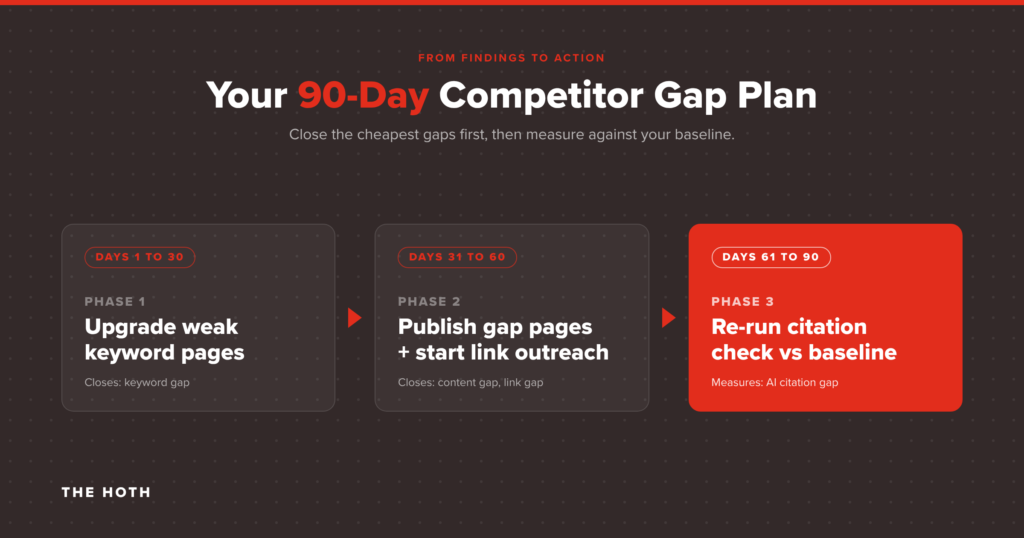
- Days 1 to 30: Upgrade the weak keyword pages. Add direct answers near the top, tighten internal links, and fill obvious content holes. These moves are cheap and tend to show results first.
- Days 31 to 60: Publish the one or two new pages your content gap analysis justified, and start link outreach to the targets you filtered.
- Days 61 to 90: Re-run the citation check on the same 20 queries, compare it with your baseline, and decide what goes into the next quarter’s plan.
How often should you redo the analysis?
Run the full four-gap analysis twice a year. In between, do a light monthly check: your priority rankings, any new domains appearing on page one, and a re-run of the citation check on your top queries. AI citations move faster than rankings, so that monthly look matters more than it used to.
Should you run a competitor analysis yourself or hand it off?
Run it yourself if you have the tools, a few days each quarter, and someone ready to act on the findings. Hand it off if the analysis keeps getting done and the fixes keep not happening, which is the most common way competitor research fails.
Everything in this guide can be done with free tools and a spreadsheet. A good first step is our free SEO report tool, which grades your on-page SEO, mobile readiness, and technical basics so you know where your own site stands before you compare it with anyone else’s.
The hard part is rarely the analysis. It’s the follow-through, and that’s where most in-house plans stall. It’s also the gap our managed SEO team closes. Your dedicated SEO manager runs the competitive research, builds the strategy, and handles the link building, content, and technical work that comes out of it, with AI visibility built into the plan from the start.
Frequently asked questions about SEO competitor analysis
What’s the difference between SEO competitor analysis and competitive analysis?
A competitive analysis looks at a rival’s whole business: pricing, product, and positioning. An SEO competitor analysis looks only at search visibility, meaning the keywords, links, content, and AI citations that decide who gets found.
How many competitors should I analyze?
Three to five. Fewer than three and you can mistake one competitor’s quirks for a pattern. More than five and the data gets too big to act on.
What tools do I need for an SEO competitor analysis?
Free tools cover the basics: a competitor finder, a keyword gap tool, and a backlink checker. A paid platform such as Ahrefs or Semrush adds link intersect reports and larger exports. For the AI citation gap, manual checks and a spreadsheet are enough to start.
Can I see which competitors AI tools recommend?
Yes. Search your priority queries in Google, note the domains the AI Overview cites, then ask the same questions in ChatGPT or Perplexity. Date each check, since answers change.
How long does it take to see results from closing competitor gaps?
Upgrades to pages that already rank tend to move first. New pages and new links take longer, because Google needs time to crawl, index, and trust them. Give it a full quarter before you judge the overall direction.
Final takeaways: SEO competitor analysis
A competitor analysis is only as good as the plan it produces. Pick three to five competitors, measure the four gaps, work the high-impact, low-effort items first, and re-check your citation baseline every month.
The brands that win in 2027 won’t just rank above their competitors. They’ll be the names AI answers recommend when buyers ask. If you’d rather have a team run the analysis and do the work it uncovers, book a call and we’ll show you where your competitors are winning and what it would take to close the gap.
Leave a comment